Sunday, 23 December 2012

Book Review: Charles Dickens 15 - "Our Mutual Friend"


Charles Dickens in 1862

After Charles Dickens completed Great Expectations in June, 1861, he moved down to Gad’s Hill Place – his house near Rochester in Kent – for the summer. He spent a lot of time preparing a new series of public readings that had been set for the coming autumn. He wanted to expand his repertoire of material, so he worked up readings from Nicholas Nickelby (“Nicholas Nickleby at Yorkshire Schools”), a short story from his former magazine Household Words (“Mr. Chops, the Dwarf”), Pickwick Papers (“Mr. Bob Sawyer’s Party”), and David Copperfield (“Storm at Yarmouth”).
Dickens used old copies of his magazine instalments of the novels, in order to cut and paste prompt-copies for each reading. He completely revised the book sections that he used. He would choose scenes that were powerfully dramatic, or very funny – removing any references to sub-plots or incidental characters. He would also excise any political or social references; he didn’t think they were appropriate for an event that was strictly “entertainment”. Dickens added stage directions in the margins – reminding himself about the physical gestures and vocal effects he wanted to use, in order to make his presentations more dramatic, more effective.
The autumn tour – his second major public-reading tour of England – ran from late-October to the end of January. It didn’t start well at all. There was less magnetic energy between himself and the audience than Dickens was used to. More importantly, his extremely competent manager, Arthur Smith – who had previously handled every aspect of these events with punctilious care – had suddenly died. His replacement, Arthur Headland, was incompetent – constantly making serious mistakes, which made Dickens mad, because he expected precision about these matters.


Hanover Square Rooms - an engraving from 1843

The following spring, Dickens did another series of readings. He was keen to earn more money, in order to defray the growing expenses he was incurring supporting his family and friends. He also thrived on the applause and adulation he received from his loyal fans. This new season of readings was done in London’s Hanover Square Rooms, instead of being spread around the provinces. Dickens eventually began organising and rehearsing the dramatic and gruesome scene from Oliver Twist which described the murder of Nancy by Bill Sykes. The horror of the scene, and the intensity with which he delivered it, made Dickens think twice about doing it in public. He avoided it for five years; but when he eventually began performing it, he did it constantly, and it proved to be both physically and emotionally exhausting for him.
In June, 1862, Dickens began making regular visits to Condette – a village ten kilometres south of the town of Boulogne, in northern France. The reason for these regular visits – known to only a few of his most intimate friends – was to visit Ellen Ternan. He had set up Ellen and her mother in a small house there. They were close enough – only thirty kilometres south of Calais – to be readily accessible to Dickens, but far enough away to be safe from the prying eyes and ears of London society.

Ellen Ternan
The exact nature of the relationship between Dickens and Ellen Ternan is the subject of much conjecture. Clearly, Dickens was obsessed with this young woman. He pursued her; he financially supported her; and made all sorts of clandestine arrangements so that he could spend time with her – without arousing public suspicion. Claire Tomalin, author of a recent biography of Dickens – Charles Dickens: A Life (2011) – also wrote a book about their relationship, The Invisible Woman: The Story of Nellie Ternan and Charles Dickens (1991). She is virtually certain that they had a sexual relationship, which resulted in a child (who died in early childhood). Other biographers, including Peter Ackroyd, are more cautious. Ackroyd concedes that it is generally assumed that their love was consummated, but he suggests that it is possible that they had a sexless union. He argues that purity and innocence was important to Dickens; and their liaison may have been similar to the love Arthur Clennam felt for Little Dorrit. Dickens would have considered his sexual passion for Ellen as illicit and, therefore, creating a strong sense of guilt. He was, after all, still married to Catherine, although they had been legally separated for about four years (since 1858). He was twenty-seven years older than Ellen, and would have viewed her like one of the young, idealised virgins in his novels. The rumours of an illegitimate child come primarily from Kate, Dickens’s favourite child. She and her brother Henry both claimed, long after their father’s death, that Dickens and Ellen had a son, who died in infancy.
Throughout 1861 and 1862, Dickens had plans to begin work on a new novel – a long novel, like Little Dorrit, that would be published in the familiar format of twenty monthly instalments. He had some ideas, but no clear plot. Things constantly upset any hope for the kind of sustained, settled period he needed to focus on a long campaign of serious writing: there was the constant travelling, the reading tours, several bouts of illness, and family and business obligations – not to mention the weekly chore of editing his magazine, All The Year Round. And, as he grew older, there were more and more deaths of friends and family to throw him off balance. In the second half of 1863, for example, both his mother-in-law, Mrs. Hogarth, and his own mother, Elizabeth Dickens, died. His mother’s death was somewhat of a relief to the family; she had been in a state of mental and physical decline for a long time.


Wood engraving by E.G. Dalziel (1911)

In the late autumn of each year, Dickens exerted a special effort on his magazine’s Christmas edition. This was an important annual source of income for him; the Christmas editions usually sold about 200,000 copies. In the 1863 version, he wrote a Christmas story for the Magazine called “Mrs. Lirriper’s Lodgings”. The portrait he gave of its title character was a fictional tribute to his mother. It was similar to his early work – poignant and very funny. It was one of the most popular things he ever wrote, and that Christmas edition sold over 200,000 copies.


Dickens began thinking about his novel again. He entered into negotiations with the publishers Chapman and Hall about the terms for this new work – his first long novel for seven years. He wanted £6,000 for half of the copyright. And he was given it. He began writing Our Mutual Friend in November, 1863. There were some characters and themes that had been in his mind for several years. He had written notes on a character called Podsnap way back in 1855. He had used the phrase “our mutual friend” three times in Little Dorrit. But, as his first biographer and confidant, John Forster, would recall later, there were three main sources for the foundation of this new novel.

Opening Scene: Jesse Hexam & Lizzie Hexam retrieve a body from the Thames

The first source, Forster wrote, came from wanderings that Dickens had made during the writing of his previous book, Great Expectations. He had been strolling down by the bank of the Thames, when he saw handbills posted, which provided “dreary descriptions” of people who had drowned in the river. This suggested to Dickens the characters of Hexam and Riderhood, the waterside men who made a “ghastly calling” by fishing corpses out of the river at night. “I think,” Dickens had written, “a man, young and perhaps eccentric, feigning to be dead … and for years retaining the singular view of life and character so imparted, would be a good leading incident for a story.” That young man would be John Rokesmith, aka John Harmon.
The second source Forster mentioned were ideas Dickens had for other major characters. He planned to make greed and social position central themes of the book. He had the notion of a man and woman who both married each other primarily for their money, only to discover soon after the wedding that neither of them, in fact, had any money. After finding out their mistake, Dickens recalled, they would “enter into a league and covenant against folks in general.” These would become the Lammles. Dickens also planned to create a couple he thought of as Perfectly New people – what we call today nouveau riche. “Everything new about them,” he wrote, “… new like the furniture and carriages – shining with varnish, and just home from the manufacturers." And these would be the Veneerings; like veneer – all surface, no depth.

Mr. Riah and Jenny Wren

The final thing Forster talks about is Dickens intention to put a benevolent old Jew in his new story – called Mr. Riah, a generous and noble character who works for a villain named Mr. Fledgeby (“Fascination Fledgeby”). Dickens’s motivation was to make amends – long after the fact – for his portrait of Fagin (“the Jew”) in Oliver Twist. In the midst of the monthly run of Oliver Twist – back in 1838 - he had received a letter from a Mrs. Eliza Davis complaining about his characterisation of Fagin. She argued that he “encouraged a vile prejudice against the despised Hebrew”, and that he had done a great wrong to the Jewish people. In a letter back to Mrs. Davis, Dickens replied in some detail that she had misinterpreted his real attitude – that he bore no ill-will or prejudice toward Jews. His immediate response had been rather defensive, but he must have thought long and hard about her opinion, though, because in the final sections of Oliver Twist he drops the constant use of the term “the Jew” – favouring simply the name Fagin. And in Our Mutual Friend, Dickens not only includes the upright and kind Mr. Riah, who works for a nasty ‘Christian’ money lender, he also has Lizzie Hexam working for Jewish employers. When a clergyman expresses concern about her remaining with them, Lizzie says: “I think there cannot be kinder people in the world.”

Dust heap at King's Cross - watercolour from 1837

Another major source for the new book was an article that R. H. Horne had submitted 13 years earlier (13 July, 1850) to Dickens’s former magazine Household Words. The article was titled “Dust; or Ugliness Redeemed”. It was about so-called “dust heaps” – huge piles of residue from coal fires mixed with domestic garbage. Elements of Horne’s attitude towards these heaps – especially the notion of them as places of decay, death and resurrection (the phoenix rising out of the ashes) – would emerge in Dickens’s novel.
By late January of 1864, Dickens had written only the first two monthly issues. He planned to have at least five instalments completed before publication began. That would be a lot more than usual, but he realised that he was not writing as quickly and as easily as he had in the past. He also had anticipations of being regularly interrupted by social events. Posters, handbills and advertisements promoting the book were spread throughout London by the end of April. Its first issue appeared in May.

Front cover of Our Mutual Friend
Our Mutual Friend is Charles Dickens’s fourteenth novel. It was his last complete novel. It was published in nineteen monthly instalments from May 1864 to November 1865 by Chapman and Hall. Each issue, as usual, had 32 pages of text and two illustrations, and cost one shilling. The final instalment was of double-length and was priced at two shillings. The illustrations were not done this time by Hablot Knight Browne (‘Phiz’), but by Marcus Stone. Dickens had fallen out with Browne (who had been his artist-collaborator for about 27 years – since the very first novel, The Pickwick Papers). The problem went back to Dickens’s separation from his wife, Catherine. He had severed his relationship with the publishers Bradbury and Evans because Frederick Evans had had the temerity to criticise Dickens’s behaviour towards his wife. Dickens not only transferred the publication of his novels back to Chapman and Hall, but he also closed up the magazine Household Words – which had been a nine-year partnership with Bradbury and Evans – and started a new periodical called All The Year Round. Dickens had not been best pleased when ‘Phiz’ began doing illustrations for the magazine that Bradbury and Evans had set up as a rival to Dickens’s All The Year Round. So he switched to someone else to illustrate Our Mutual Friend. Hablot Knight Browne was terribly offended. Marcus Stone was not as good as Hablot Browne. He was younger and keener, and certainly more contemporary. But his style was so different: Browne had been vivid and often grotesque, working with steel etchings; Stone favoured wood prints, and his approach was naturalistic and rather sentimental. Dickens had always conferred closely with Browne about which scenes to illustrate, so it was rather odd that he showed a much more casual attitude with this younger, less-experienced artist. He simply invited Marcus Stone to choose his own “good moments” from each month’s instalment. Dickens was getting older. Other non-writing concerns were wearing him down – and there seemed to be a decline in his enthusiasm and concern for the many details of novel-preparation. The first issue of Our Mutual Friend sold about 35,000 copies. Interest in the book waned, however, during its run; by the end of its serialisation, it was only selling about 19,000 copies.
Dickens's working notes for the first section of  Our Mutual Friend

Our Mutual Friend is the final book of Dickens’s so-called London Trilogy – the three late-period books centred on a critique of society in the English capital. Bleak House had fog as its dominating symbol; in Little Dorrit it was the prison. For Our Mutual Friend, Dickens used the gigantic dust heaps – the mounds of coal-fire residue and domestic detritus collected from London’s residents – as the book’s defining image, suggesting rot, ashes, mud, decay, death and resurrection. But he also used water as an important symbol, with the ambivalent notions of life and death being tied up in it – life emerging from it, being dependent on it, and succumbing to it, through drowning. Dickens was focused on a change he sensed in civilisation – the growing attachment to financial speculation, foreign investment, and the idea that the worth of everything lay in its monetary value. The city was now a world primarily of barter and exchange.


Dickens photo from 1865

Dickens’s writing came much slower these days. He found it difficult switching back to monthly instalments, after producing his previous two novels in weekly issues. He said the effort left him “quite dazed”. Dickens’s notes show how he built each new monthly instalment carefully from the last. He planned a more unified structure. His narrative style was a lot more fanciful than usual – similar to what he did in Bleak House.


After the self-revelation of his previous book, Great Expectations, Dickens turned his attention back to a sharp attack on English life. The book is full of derision for English social behaviour. In fact, most of social life in Our Mutual Friend is seen as nothing more than a game, tainted by pretension and false values. Dinners are an empty ritual. Dickens, who had always been a life-of-the-party type, began to hate parties. As he put it, he would invariably “bolt” very early, or, when the time was right, he would “slip away”. This formerly gregarious host had now become primarily a self-contained man. He hated all of the dreadful gossip; and he must have feared inadvertent comments about his wife Catherine and rumours spreading behind his back about his relationship with Ellen Ternan. His general hatred for this social scene shows in the book – his sympathies generally are with the odd characters and the social outcasts. The radicalism of his youth seemed to have erupted in his last novel.

Staplehurst Train Crash of June, 1865

Charles Dickens looked much older than his 53 years. He had aged rapidly during the last few years. His face betrayed the conflicts and anxieties which beset him. And he began to suffer episodes of gout – one of his feet began to swell because of vascular degeneration. And then came a traumatic event that had a major impact on his physical and emotional health. He was coming home from France in June, 1865 with Ellen Ternan and her mother, Mrs. Ternan. They were on the Folkestone-to-London train; and, just before reaching the station at Staplehurst, a signalman mistakenly directed the train to proceed ahead, even though a section of rail had been removed for repairs. The train was going about 50 mph and derailed at a bridge. It jumped a forty-two feet gap in the rail. Seven of the eight first-class carriages plummeted down from the bridge into the riverbed below. Dickens’s carriage was half off the track, but it didn’t fall with the others. He helped get the Ternans out of their carriage, and then he climbed down to assist with the care of the wounded and dying. He spent a long time helping, and witnessed several individuals die of their wounds. And then he clambered back up to his precariously-balanced carriage in order to retrieve the manuscript of his latest monthly instalment of Our Mutual Friend, which he had left in his overcoat pocket. The later inquiry into the accident was a big worry for Dickens; he was anxious that it not be revealed publicly with whom he had been travelling. He managed to have this information kept secret. More important than this immediate anxiety, however, were the long-term physical and psychological effects. From now on, Dickens – who travelled a great deal for both business and private reasons – suffered intense anxieties about travel.
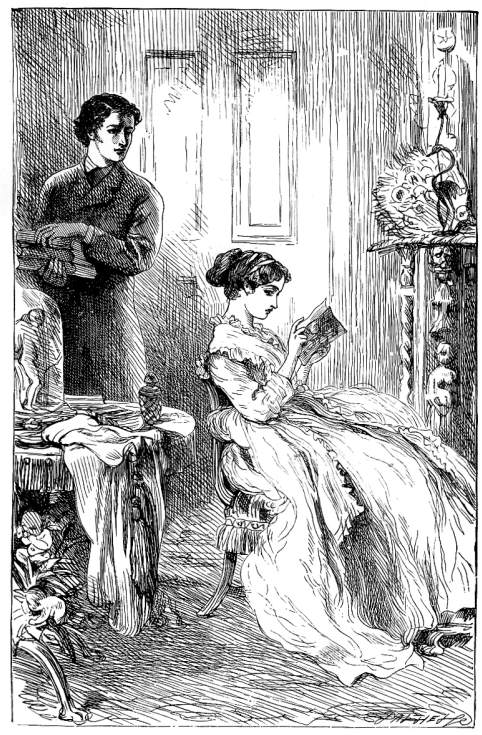
John Rokesmith & Bella Wilfer
By August, Dickens was working on the novel’s final issue – the usual double-number. When he had it finished, he wrote – for the very first time – a Postscript for the novel, in which he justified the narrative method he had adopted in the book, and provided a brief description on the Staplehurst crash. He also mentioned the problems of serialising a novel in monthly sections. It sounded rather defensive – as though the author was anticipating a critical backlash. The response was mixed. One of the worst comments came from the young Henry James, who called the book “the poorest of Mr. Dickens’s work. And it is poor with the poverty not of momentary embarrassment, but a permanent exhaustion.”


Noddy Boffin looks for miser books
Of the three large, late-period novels dubbed the “London Trilogy”, Our Mutual Friend was my least favourite. The plot is an odd contrivance. The mystery of John Harmon’s fate is, strangely, revealed rather early to the reader. And then the change of character that Noddy Boffin goes through – tainted by the money he inherits and the social position it gives him – is later revealed as a sham, and a subterfuge planned with his secretary, Mr. Rokesmith. As G. K. Chesterton points out, in his 1907 introduction to the Everyman Edition, the original change of attitude seems to be Dickens’s original intention – another example of the corruption brought by money – but then altered later because of difficulties that Dickens had resolving the plot in the limited space he had available.
The portraits of the various social hypocrites that make up the circle of self-centred acquaintances that meet for dinners throughout the book – the Veneerings, the Lammles, the Podsnaps – are intitially of interest for the broad, satirical swipe Dickens aims at them. This is the social realism that Dickens aimed for in this book. But they don’t do much of interest, and they don’t advance the main plot. Mr. Podsnap – whom Peter Ackroyd identifies as a less-than-subtle portrait of Dickens most intimate friend and business advisor John Forster – serves as a representative of that disdainful society which condemns the relationship between Eugene Wrayburn – “one of their own” – and the low-born Lizzie Hexam - daughter of the apparently disreputable waterside man Jesse Hexam. Silas Wegg, who enters the story as a “balladmonger” and the keeper of a very small fruit-stall, is intended by Dickens to be one of his larger-than-life comic rogues. I found him actually to be quite tiresome, and the extended scenes between him and his taxidermist friend Mr. Venus seemed to drag on with little import or entertainment.

Bradley Headstone and Roger Riderhood

Of much more interest in this book are several of the female characters – and the love-interests they provoke. Bella Wilfer is the woman whom John Harmon was supposed to marry upon his return to England, in order that they both benefit from the will of the wealthy Mr. Harmon. She enters the story as a self-regarding and rather shallow person, but as the story progresses, she develops into an admirable character with whom, sure enough, John Harmon falls in love, regardless of any financial consideration. She has a close, rather flirty relationship with her father. Lizzie Hexam is one of those Dickens innocents who spend most of her time trying to protect her virtue. She is attracted to the high-born Eugene Wrayburn, but also runs from him, fearful that he is only interested in using her for his own satisfaction. She later heroically saves his life – using her skill as a boater to pull his battered body from the river Thames. She is also pursued by the schoolmaster Bradley Headstone, who is so obsessed with her that he attempts to kill her upper-class admirer. Headstone is an interesting character – one of those fevered criminal minds that Dickens puts us inside. And then there is Fanny Cleaver (“Jenny Wren”), a crippled young woman, who has successfully established a small business as a dolls’ dressmaker. She is linked to Mr. Riah, the noble and kind employee of the nasty Mt. Fledgeby. Jenny is another of those interesting characters who are physically weak, but actually very strong emotionally.


In Our Mutual Friend, London is an ugly and corrupt place. It’s a scene of moral and physical degradation – fog, rain, mud, decay, and death. It’s still the prison environment of Little Dorrit, a sad and depressing place. Is it any wonder that Dickens spent most of his time now either at Gad’s Hill Place in Kent, or near Boulogne in France. At the conclusion of Our Mutual Friend – which would turn out to be his last complete novel, Dickens was already thinking about his next book. And that one would be set again in the Rochester area – the milieu of Great Expectations – the scene that had inspired him to create a much more popular and successful novel.


[2012 is the bicentenary of the birth of Charles Dickens. Lots of special events and activities are planned in England this year. Back in 2009, my good friend Tony Grant (in Wimbledon, UK) and I did a pilgrimage to three key Charles Dickens destinations - his birthplace in Portsmouth (the house is a Museum), the house he lived at on Doughty Street in London (now the chief Dickens' museum), and the town he lived in as a child on the north-coast of Kent (Rochester). 

These visits inspired me to begin reading through all Dickens's novels. By last summer I had done six, but stalled in the middle of Dombey and Son. I thought what I could do to mark this special year of Dickens was to start again, read through all of his novels inside the year, and blog about them. So this is the fifteenth of a series.]

Next: The Mystery of Edwin Drood

[Resources used: "Introduction" to Our Mutual Friend by Andrew Sanders (1994); Dickens by Peter Ackroyd (1990); Charles Dickens: A Life by Claire Tomalin (2011); "Portraits of Charles Dickens (1812-1870)", an excellent web-page collection of Dickens pictures.  Dickens Portraits ]


Monday, 17 December 2012

Book Review: Charles Dickens 14 - "Great Expectations"


Dickens (49 yrs.) photo by G. H. Watkins (1861)

Charles Dickens finished writing A Tale of Two Cities by early October, 1859 – just before setting off on a brief (for him) provincial tour of England, in order to deliver a series of fourteen public readings. He did more of these readings through the Christmas season – what had now become an annual event at St. Martin’s Hall in London – focusing, as usual, on “A Christmas Carol”.

Dickens decided to stay in London through the winter months, and he rented out the family’s house at Gad’s Hill Place in Kent. He was anxious to plan out, far in advance, the novels that would be serialised in his weekly magazine, All The Year Round – after A Tale of Two Cities had finished its run at the end of November. He had already agreed to publish Wilkie Collins’s The Woman in White, but knowing – from bitter experience – that a successful serial was crucial in maintaining good sales of his periodical, he looked even further ahead. Dickens had admired George Eliot’s “Scenes From Clerical Life” (1858) - published in Blackwood’s Magazine - and her first novel, Adam Bede, which had recently been released (1859). He asked her to submit a story. She toyed with the idea for a while, but then declined, saying that she just didn’t have the time. He then approached Elizabeth Gaskell and Charles Lever.

Opening scene from David Lean's 1946 film of Great Expectations:
Magwitch (Finlay Currie) meets Pip (Tony Wager)

In January, 1860, Dickens began writing a series of essays for All The Year Round using the persona of the “Uncommercial Traveller”. Eventually, this collection stretched all the way to October – sixteen essays in total. The spectre of his lost childhood haunted these nostalgic reminiscences: stories full of unhappy and solitary wandering, looking back at his past with deep longing and regret. It was in one of these essays (“Travelling Abroad”), for example, that he recalled himself as “a queer young boy” walking past Gad’s Hill Place, near Rochester, with his father, and his father telling him that he might eventually own a home like that, if he were to persevere in life.
Dickens was desperate to keep busy; he was dissatisfied with life, and his days were marked by melancholy. Since the separation from his wife Catherine, the family home was not a happy place. As an intimate of the family noticed, Charles had become “restless, despotic, and miserable.” He tended to be remote and unfeeling with the children. He liked his children when they were infants, but became much less affectionate as they grew older. He hated noise in the house and was constantly lecturing them about their untidiness. They had become a sad family now, because of the parental rift. And most of the children lived in the shadow of their extraordinary father – sensing that they were “failures” in their father’s eyes. To top it all off, his favourite child, Kate – she was most like her father – announced that she was planning to marry Wilkie Collins’s younger brother Charles and move out of Gad’s Hill Place. Dickens was very upset by his daughter’s marriage; he didn’t really approve of her intended partner, and he felt he was being abandoned at a particularly difficult time.


Pip teaches Joe Gargery to read

Dickens then decided to sell Tavistock House in London and spend the summer and autumn months of 1860 at Gad’s Hill Place in Kent. He sold the London home by August for 2,000 guineas. He was happy to rent a new place for the family in the City, if that became necessary. Down in Kent, he began to make continual improvements at Gad’s Hill – these renovations and refurbishments would go on for the next ten years.
In August of 1860, Dickens began “meditating a new book.” He would start actually writing it three weeks later. In the interim, he set about a campaign of ignoring the immediate past and planning steadfastly for the future. In a general tidy-up of Tavistock House prior to selling, he suddenly burnt all of his past correspondence. In an apparent need to wipe out memories of his married life, and to re-set the past according to his new agenda, he immolated baskets and baskets of letters – a rich collection of correspondence from the likes of Thomas Carlyle, William Thackeray, Wilkie Collins, George Eliot, and Arthur Tennyson. Letters received for the past twenty years of his life. What a loss! In his struggle to establish a new life, and to settle himself after the turmoil of the last couple of years, he was starting to build layers of regret and, even, hatred for people and situations from the past.


Manuscript page - first page of Great Expectations

So Dickens began writing Great Expectations at the end of September, 1860. The germinating idea – the relationship between the convict (Magwitch) and the innocent boy (Pip) – came to him first as an idea for one of his “Uncommercial Traveller” essays. He described the notion as “a very fine, new, and grotesque idea.” The original form for the novel (length and frequency) had to be changed because of the situation at All The Year Round. A Tale of Two Cities had been followed by Wilkie Collins’s very popular A Woman in White. When it was completed in late August, 1860, Charles Lever’s novel – A Day’s Ride – began its run. It proved to be a failure, unfortunately, and sales of the magazine plummeted. Yet again – like the time he used The Old Curiosity Shop to salvage the magazine Master Humphrey’s Clock – Dickens was called upon to revive his periodical by writing a novel of his own. It meant creating a weekly serial about the same length as  A Tale of Two Cities – the previous Dickens novel, which had inaugurated his most recent weekly magazine. By early October Dickens had selected the name of the novel and started work on the serial in its new format. He planned to publish the first instalment in December, and he wanted to have two months of story in hand by then.

Pip cries after telling Biddy he wants to be a gentleman

In the very early stages of composition, Dickens read David Copperfield again, in order to ensure that he didn’t include unconscious repetitions of the boyhood tale he had written in that book. He reported to his close friend John Forster that his re-acquaintance with the earlier book was quite an emotional experience; he was “affected by it to a degree you would hardly believe.” By the middle of October Dickens had four chapters complete. He found that he was writing with such ease and spontaneity that he could ignore the working notes that he had prepared. And he didn’t bother referring to anything in his notebook, apart from retaining a few of the names he had come up with for some of the novel’s characters. Great Expectations, Dickens wrote, was to chronicle the life of a “boy-child like David [Copperfield]”. The protagonist was Pip, an uneasy, guilt-written young lad. Dickens went down to Gad’s Hill from London, in order to concentrate on his writing; and by the end of October he had another three chapters done – seven in all. When he did work in London, Dickens preferred to work in the bachelor quarters above his All The Year Round office in Wellington Street North.


Great Expectations issued in All The Year Round

Great Expectations, Dickens’s thirteenth novel, was issued weekly in All The Year Round from 1 December, 1860 to 3 August, 1861. The magazine was printed by Chapman and Hall. Dickens divided the novel into three parts, like A Tale of Two Cities, but he didn’t package the weekly instalments each month into a monthly issue. He was satisfied to release the 36 consecutive numbers just in All The Year Round. And, unusually for him, the length of the weekly parts varied. Shortly after the serialisation was complete, Chapman and Hall published the book in three volumes (October, 1861) – a common practice in the nineteenth century, although this was actually the first time that a Dickens novel was issued in this manner. Ironically – for a novel that is so intensely visual, full of compelling scenes – the original weekly instalments of Great Expectations went unaccompanied by any illustrations. That was the practice in Dickens’s magazines. Pictures were added in later versions of the book – like the set of F. W. Pailthorpe illustrations used in the 1885 edition.


Aged P. is introduced to Pip by Wemmick
(engraving by F.W. Pailthorpe)

The early response to Great Expectations was favourable. It was considered a return to the humour and pathos of his earlier, more accessible fiction. Dickens was delighted and often crowed about its popularity in the correspondence he was writing during the novel’s run: “It seems universally loved,” he wrote in one letter; “I suppose because it opens funnily, and with an interest too.” But he was not well at all during the writing of this book. He was constantly in pain – suffering from a condition he referred to as “facial neuralgia”. He experienced chronic pains in his left side, too – early symptoms, probably, of the stroke that would eventually kill him. He felt overworked. He always was pushing himself too much. He found a new place to rent at 3 Hanover Terrace, which faced Regents Park. He was planning to finish his novel by early June, but his work was interrupted again by a new series of six public readings.

Great Expectations is a bildungsroman – a coming-of-age novel. It is narrated in the first-person – only the third of Dickens’s books to feature this device. In Bleak House half of the story is told in first-person by Esther Summerson, a young woman. That made it much different in technique to David Copperfield and Great Expectations, where the male first-person narrators are both stand-ins for the real Charles Dickens. Their stories feature locations and incidents from the author’s own life. Copperfield’s early childhood development includes David’s experiences working at the Murdstone and Grinby factory – reminiscent of the Warren’s Blacking Factory, near the Hungerford Steps, where Dickens worked as a twelve-year old boy, whilst his profligate father resided in the Marshalsea Debtors’ Prison in Southwark, with the rest of the family. Just after Copperfield begins his humiliating interlude at the factory in London, he befriends Wilkins Micawber, a delightful portrait of his always-debt-ridden father. Pip’s early experiences in Great Expectations are set in the marshes of Northern Kent, near where the River Medway empties into the North Sea. Dickens grew up here, in Chatham and Rochester, for about five years (1817-1822) – between the ages of four and nine. Dickens draws heavily on those early years – not so much for incidents and characters, but more for mood and setting.

Alec Guinness as Herbert Pocket and John Mills as Pip in David Lean's
Great Expectations (1946)

The crucial difference in these two coming-of-age stories is the level of self-revelation they contain and the consistency with which the author’s self-knowledge is woven into the fabric of the book. David Copperfield explores Dickens’s tortured memories of the blacking factory, but as Copperfield grows into young adulthood, his growth as a character falters. David becomes rather bland – the latter half of the book tells us little about his development. Great Expectations, however, is more directly autobiographical than David Copperfield, and much more honest – it is shot through, from beginning to end, with a consistent account of Pip’s moral failings; and it provides a profound treatment of how a man, desperate to become a gentleman with expectations, descends into a snobbish selfishness, only to be redeemed at the end, once he realises his mistake and acts upon it. G. K. Chesterton points out, in his preface to the first Everyman Edition of the novel (1907), that the title Great Expectations could be applied to all of Dickens’s books, because all of his books “are full of airy and yet ardent expectations of everything.” George Bernard Shaw praised the novel as “all of one piece and consistently truthful”. And he wrote to G. K. Chesterton that the story of the adult Copperfield reveals nothing about Dickens’s inner life: “Clennam [from Little Dorrit] and Pip are the real autobiographies.” And George Orwell, a big Dickens fan, wrote that “psychologically the latter part of Great Expectations is about the best thing Dickens ever did.” If we look at the personal turmoil that Dickens had been going through for the last few years, it is easy to see how he broke through to this intense level of painful self-knowledge. Many of the issues he deals with In Great Expectations – passion, snobbery, false expectations, selfishness, passion, meanness – reflect the personal demons he was fighting in his own life. So the reason Dickens abandons the socio-political focus of Bleak House and Little Dorrit is to pursue a more personal vision – to project his own faltering sense of self-worth onto the flawed figure of Pip. And writing the book as a bildungsroman in the first-person was an obvious narrative strategy to achieve that psychological effect.

Bernard Miles as Joe Gargery and John Mills as Pip in David Lean's Great Expectations (1946)

Some of the major characters in Great Expectations reflect aspects of Dickens’s fragile personality. Pip, of course, is the obvious example – his desperate need to escape his humble background and lead the life of a “real gentleman” of expectations, is the underlying theme of Dickens’s life. His boundless ambition and incredible work-ethic seemed linked both to his desire for social advancement and to his fear of falling into debt and poverty. Pip’s selfishness reflects Dickens’s often ruthless self-regard. Pip is a self-made gentleman (with a wrong-headed idea of how he came into his expectations), but he is aimless – he has no sense of his place in the world, and no authentic values. He becomes infected by class snobbery. Abel Magwitch, the convict, also represents elements of Dickens’s sense of himself – a beneficent figure inspired to do good for others because of underlying feelings of guilt and shame. He helps others in order to feel better about his unfulfilled dreams. And Dickens’s current passion for Ellen Ternan – tied up with feelings of thwarted love and unrealised sexual yearning – is poured into his intense portraits of Miss Havisham and Estella. Interestingly, as Michael Slater points out in his introduction to the Everyman Edition, although many commentators think Estella is a character based on Ellen Ternan, it makes more sense to see her as a portrait of Maria Beadnell, the young woman with whom Dickens had been passionately infatuated with, and who eventually rejected him because of his lack of social position. Whether based on Ellen or Maria, the theme is the same – the love for an unattainable woman.


Trabb's boy mocks the pretentious Pip

Like David Copperfield, Dickens’s other first-person coming-of-age story, Great Expectations is full of fascinating characters: Joe Gargery, Pip’s brother-in-law, a very simple man – but one of deep kindness and humility – whom Pip abandons because of his lowly position; Biddy, who becomes Joe’s wife – another of Dickens’s warm, nurturing women characters; Herbert Pocket, a good-hearted, but often ineffective friend of Pip’s during his up-and-coming early London days; Mr. Jaggers, a London lawyer, who is constantly washing his hands, because of the low-life criminals he deals with on a daily basis; the amusing John Wemmick, Mr. Jaggers’s clerk, who insists on maintaining two distinct personas – the town Wemmick, who will only discuss the legal business of his employer, and the country Wemmick, who will entertain other, more personal, issues in the privacy of his home; and the delightful Trabb’s boy – a character who particularly impressed G. K. Chesterton because he is a supreme example of Dickens’s amazing ability to capture in only a brief vignette something very profound about human nature.
 
Martita Hunt as Miss Havisham and Jean Simmons as Estella in David Lean's Great Expectations (1946)

And then there is the astonishing pair of females who inhabit Satis House – Miss Havisham and her adopted daughter Estella. Miss Havisham, in some ways, is at the centre of the story. She is surely one of Dickens’s greatest creations – she embodies a simple idea, but is fleshed-out so brilliantly that she repels us at first because of her twisted cruelty, but yet finally prompts our sympathy because of her eventual remorse for the way she has twisted the mind and heart of Estella, and caused such mental suffering for her and Pip. Miss Havisham embodies the terrible psychological cost of brooding too much on past betrayals. Estella, herself, is the ultimate femme fatale – gorgeously attractive, but with a heart of ice. Trained by a twisted mother to attract men and then torment them. From their very first meeting, Pip is helplessly enthralled by her grace and beauty. And it is Estella’s contempt for him – he thinks it is just because of his coarse manners and lowly position – that drives him to want to be a gentleman, and to reject the life and family he had been born into.

"What have I done?" - Miss Havisham begs forgiveness from Pip

Great Expectations is often thought of as Dickens’s artistic masterpiece. It is certainly my favourite Dickens novel. It was the first book of his that I read – back in the mid-60s. And then it was a set book for me in two different English courses at university. It’s the book of his that I know best. And every time I read it, I am caught up again in its spell. Unlike many of Dickens’s other novels – which can be very discursive, and structurally flawed – this book is tightly plotted, and the wonderful cast of characters is used economically both to advance the plot and illustrate its themes. Although  readers at the time applauded Great Expectations as a return to the humour and pathos of the past, it is still a book suffused with sadness. As Michael Slater points out, everything in the story is portrayed as “grey, rainy and melancholic”. And the narrative tone is one of disillusionment and sadness, mixed with ironic and knowing reflections on human nature – the moral failings of people and the corruptions of society. And yet despite all that, the book still seems uplifting – because its central character, its protagonist, is redeemed by his hard-won self-knowledge.


Estella allows Pip to kiss her

Charles Dickens finished writing Great Expectations on 11 June, 1861. All the physical problems he had been enduring (“facial neuralgia” and pains in his side) suddenly went away. When he showed the proofs of the final chapters of the novel to his friend Edward Bulwer-Lytton, a prolific novelist and playwright, who had been following the monthly issues with great interest, Bulwer-Lytton argued with Dickens to change the ending – which had Pip and Estella meeting for the very last time and going their own separate ways. He considered that ending too harsh. He thought their redemption (Pip through self-knowledge and kindness, Estella through suffering) deserved something better. Dickens relented. He went back to Gad’s Hill Place and within a few days he revised the conclusion. In the final scene, Estella says they will “continue friends apart”; but Pip declares, as they leave the ruined grounds of the former Satis House: “I saw no shadow of another parting from her.” It’s an ambivalent ending that allows you to decide their fate for yourself. George Bernard Shaw and George Orwell both thought the original ending was better, because it was more real. When I first read the book as a teenager, of course, I wanted Pip to finally win Estella. Now I see that Shaw and Orwell were right. Regardless of how the book ends, however, the journey itself is a wonderful ride.

John Mills as Pip in David Lean's Great Expectations (1946)


[2012 is the bicentenary of the birth of Charles Dickens. Lots of special events and activities are planned in England this year. Back in 2009, my good friend Tony Grant (in Wimbledon, UK) and I did a pilgrimage to three key Charles Dickens destinations - his birthplace in Portsmouth (the house is a Museum), the house he lived at on Doughty Street in London (now the chief Dickens' museum), and the town he lived in as a child on the north-coast of Kent (Rochester). 

These visits inspired me to begin reading through all Dickens's novels. By last summer I had done six, but stalled in the middle of Dombey and Son. I thought what I could do to mark this special year of Dickens was to start again, read through all of his novels inside the year, and blog about them. So this is the fourteenth of a series.]

Next: Our Mutual Friend

[Resources used: "Introduction" to Great Expectations by Michael Slater (1992); Dickens by Peter Ackroyd (1990); "Portraits of Charles Dickens (1812-1870)", an excellent web-page collection of Dickens pictures.  Dickens Portraits ]

Tuesday, 11 December 2012

Book Review: Charles Dickens 13 - "A Tale of Two Cities"


Photo of Dickens (46 yrs.) by G. H. Watkins (1858)
The origin of A Tale of Two Cities – Charles Dickens’s famous novel set during the French Revolution – goes back ultimately to Thomas Carlyle’s influential book The French Revolution: A History, which was published in 1837, when Dickens was 25 years old. Dickens became obsessed with the book, and he read it hundreds and hundreds of times. He eventually met Carlyle and they became friends – the Scottish author came to see some of Dickens’s amateur theatricals, and he sometimes offered praise and critiques of the younger writer’s novels. When Dickens was writing A Tale of Two Cities through most of 1859, he carried Carlyle’s book around with him all the time – there is a photograph of Dickens that shows him reading it in the garden at Gad’s Hill Place.

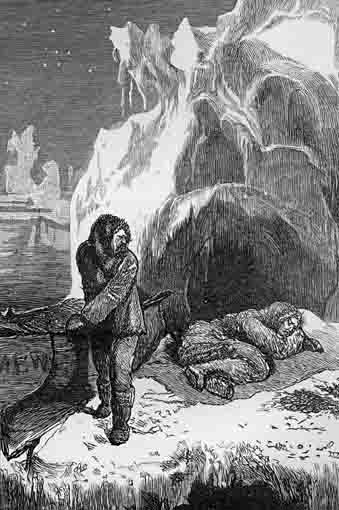
Of more immediate influence on A Tale of Two Cities were two plays: The Frozen Deep by Wilkie Collins, and The Dead Heart by Watts Phillips. Dickens had long been fascinated by accounts of the doomed Arctic voyage of the John Franklin expedition. In 1845 Franklin had attempted to find a way through the last un-navigated section of the Northwest Passage. Dickens had written several articles about the expedition for his magazine Household Words. When Wilkie Collins and Dickens were visiting Paris together in early 1856, Dickens persuaded his friend (primarily a novelist) to write a play based on the Franklin expedition that could be presented at the next Dickens family Twelfth Night celebration at Tavistock House. Although Collins wrote the drama, Dickens was constantly giving him advice; and later he heavily revised it and added some scenes of his own. And, as usual, Dickens took charge of virtually every aspect of the production.
Poster for Twelfth Night play at Dickens's home
The Frozen Deep turned out to be a melodrama concerning the rivalry between two members of the expedition for the same woman. Wilkie Collins played the part of the expedition leader, the successful suitor; and Dickens acted the part of Richard Wardour, who had been rejected. Wardour is presented as an ambivalent character who is motivated both by love and anger. But at the conclusion of the play, Wardour sacrifices himself, in order to save the life of his rival. Dickens revised and edited his part – creating a good man whose heart and soul had been frozen by his loss of love. As Peter Ackroyd points out in his biography, the character of Wardour became a “self-revelation” for Dickens. He had always shown great ability as an actor in previous amateur theatricals, but this time his identification with the part was intense. There had often been a rather histrionic tendency in his approach to drama, but eyewitness accounts described an even more extraordinary frenzy in his acting. A review in The Leader noted the “savage energy” in his performance.

In addition to the Twelfth Night production on 6 January, Dickens’s amateur troupe gave three more performances that week - about 90 people were present for each. After the intensity of this week of performances, Dickens and Wilkie Collins took a break from work for a few days down in Brighton. During their stay on the south coast, Dickens’s friend Benjamin Webster – the actor and dramatist who ran the Adelphi Theatre in London – read to him the manuscript of a new play by Watts Phillips called The Dead Heart. It was also a story of self-sacrifice – set this time in Paris during the French Revolution, rather than the frozen Arctic. At the dramatic conclusion of this play, there is a surreptitious substitution at the guillotine.

Scene from The Frozen Deep
Six months later a special benefit performance of The Frozen Deep was mounted, in order to raise money for the family of the recently-deceased Douglas Jerrold. Jerrold – a playwright and journalist – had been a friend of Dickens for twenty years. The benefit took place on 4 July at the Gallery of Illustration in Regent Street. Queen Victoria was in attendance. Dickens had planned to raise an even £2,000 for the Jerrold family, but they fell short of the target. When he was invited by a promoter in Manchester to give several performances at the New Free Trade Hall, Dickens seized the chance to make up the shortfall.

When Dickens went north to check out the facilities in Manchester, he realised that the hall was much too large for some of his amateur actors to cope with. They just didn’t have the training to project their voices into a hall designed to hold 2,000 people. Dickens decided to hire some professional actors who could handle these new demands. And that is how Charles Dickens met the actress Ellen Ternan. He invited the entire Ternan family to participate – Mrs. Ternan and her three acting daughters: Fanny, Maria and Ellen. They were all experienced actors and had been on the stage of many of London’s top theatres.


Ellen Ternan

Ellen Ternan was just eighteen when she performed in The Frozen Deep in Manchester. According to an intimate of the Ternan family, Ellen was “outwardly placid, but firm underneath”. Dickens’s second daughter, Kate, remembered her as “small, fair-haired, and rather pretty”. “She had brains,” Kate thought, but she was actually the least talented of the three acting sisters – pushed into acting because that was what the family did (she first stepped onto the stage when she was three years old), rather than responding to a sense of vocation. Dickens became enthralled by the teenaged actress. He was forty-five years old, married, with nine children. But he seemed drawn inexorably to this attractive young woman. It was a classic mid-life crisis. Like the male protagonist of his recent novel Little Dorrit – Arthur Clennam – Dickens’s attraction to this unattainable woman was probably intensified by his sense that life’s possibilities were slipping away from him, and by his unhappy marriage with Catherine.
Meanwhile, the two performances in Manchester were such a triumph that Dickens agreed to add an extra show. And it was as he lay “dying” on the stage as the self-sacrificing Richard Wardour – near the play’s conclusion on this final night – that Dickens conceived the basic idea for A Tale of Two Cities.

1935 Hollywood version of A Tale of Two Cities - directed by Jack Conway, starring Ronald Colman

Dickens began a long, desperate pursuit of Ellen Ternan – but he had to do it discreetly, in order to protect both her reputation and his public image. He began to express what he was going through to some of his closest confidants. “Poor Catherine and I are not made for each other,” he wrote to John Forster. He turned away demonstrably from his wife in October, 1857. He instructed the maid to divide the main bedroom at Tavistock House into two rooms, by setting up a partition. He was so agitated at this time that one night he got up at 2 a.m. and walked 30 miles through the night from Tavistock House in central London to Gad’s Hill Place in Kent.
At Christmas in 1857, there was no large family party because of the turmoil in the house. But Dickens did do some more public readings. He had given a powerful speech on behalf of the Hospital for Sick Children – it helped to raise £3,000. A few weeks later he did yet another public reading of A Christmas Carol for the same benefit fund, and finally the hospital was effectively endowed for the very first time. The power of these performances led Dickens to consider these public readings as an alternate source of income. He realised that if he undertook an extended tour around the country, he could raise some badly-needed funds to stabilise his own financial situation. There was, in fact, already a tradition of writers giving public presentations – more often lectures, though, than readings. They were undertaken both as educational activities and high forms of entertainment. He did a dry run in Edinburgh to see if the public would support his readings as paid entertainment, rather than charitable activities. It was a resounding success. His first non-benefit, paid public reading was at St. Mary’s Hall in London. It was the beginning of a twelve-year run of public readings that would continue until the end of his life.

Dickens doing a public reading - a wood engraving by Charles Barry (1867)

In the early months of 1858 Dickens was still deeply estranged from his wife Catherine. In May he finally undertook to establish an informal separation between them. He wanted the whole thing to be discreet, of course, so that there would be no damage to his public reputation. To justify his actions, and to divert any possible suspicions about his growing relationship with Ellen Ternan, he began making some rather disgraceful comments about Catherine in letters to his friends. To Angela Burdett-Coutts, for example, he wrote of his wife: “She has never attached one of them [their children] to herself, never played with them in their infancy, never attracted their confidence as they grew older, never presented herself before them in the aspect of a mother.” This just wasn’t true, but Dickens really seemed to believe it. It was another example of how his imagination always seemed to trump reality.
Dickens’s friends John Forster and Mark Lemon arranged the original separation with Catherine. Her mother, Mrs. Hogarth, attempted to draw up a deed of separation. And then things started to unravel. The Hogarths were threatening to sue Dickens in the Divorce Court – precisely what he was intent on avoiding. A legal settlement was quickly arranged: Catherine would get an annual income of £600; and she would have unlimited access to the couple’s children – as long as there were no lawsuits pursued by either of them against the other. Inevitably, when news of the legal separation emerged, rumours began to circulate about Dickens’s relationship with Ellen Ternan. Foolishly – instead of ignoring the gossip – Dickens got on his high-horse and published a statement in The Times denying that there was any improprieties in his friendship with Ternan. A classic example of “the man doth protest too much.” The public statement did not eliminate the gossip, of course – it encouraged it. The whole affair (pun intended) damaged his reputation and estranged him from many former friends and colleagues. To avoid facing this sort of public scrutiny, Dickens began going down to Gad’s Hill Place regularly in July.


Painting of Dickens by William Powell Frith (1859)
In the New Year of 1859, Charles Dickens sat for a portrait by William Powell Frith. It was commissioned by his closest friend, John Forster. The painting showed Dickens at home in his study. He is wearing a velvet jacket and posed on a chair, in front of his desk. Although the detail cannot be discerned in the painting, the paper propped up on the desk is the opening chapter from his new novel, A Tale of Two Cities. Forster loved the painting; Dickens, as usual, was not fully satisfied. He said his facial expression was that of a man who had just heard that a misfortune had befallen an unfriendly neighbour! To help capture the author’s features, Frith had made use of a photograph of Dickens taken by George Herbert Watkins, a well-known professional photographer, who had done a series of photographs the previous year in his studio on Regent Street. [One of those pictures is seen at the top of this review.] The painting and the photographs revealed a serious man, looking tired after the struggles of a difficult year.


Home of All The Year Round on Wellington St.
One of the major casualties that occurred because of Dickens’s separation from his wife was his relationship with Frederick Evans – one-half of his publishing firm of Bradbury and Evans. Dickens was very upset at Evans’s critical attitude towards him. So he decided to cut his ties with them both. Negotiations began about the copyright to the novels (they had published the previous five) and the fate of the weekly magazine Household Words, which had had a run of nine years. Dickens bought out the rights to it for £3, 550. He determined to set up a new magazine as quickly as possible. It would be called All The Year Round, and would be set up in an office on Wellington Street.


Cover of the first issue of All The Year Round
 Dickens realised that he needed to establish his brand new magazine immediately by jumping straight into a new novel. He still had the rough notes he had written following that episode on the stage in Manchester (when he had been “dying” as Richard Wardour). He soon had a title – A Tale of Two Cities. It was going to be published first as weekly instalments in All The Year Round; and then bound up monthly in the familiar green-covered wrappers. The new weekly was going to look identical to Household Words – with the same size, the same page-format (with two columns), the same drab look (no illustrations), and roughly the same number of articles. He planned for the magazine to include serialised novels, short stories, and topical articles. It would also cost twopence. But, finally, for the very first time, Dickens would have complete control of his periodical; he would be editor and publisher. And his very competent friend, William Henry Wills, would continue to serve as sub-editor. Dickens advertised his new weekly with newspaper ads, handbills, placards and billboards. Because of the tremendous success of A Tale of Two Cities, sales of All The Year Round would never drop below 100,000 copies – amazing, really, given that Household Words had been selling about 35,000 – 40,000 copies.


First monthly binding of A Tale of Two Cities
 The first issue of Dickens’s new weekly, All The Year Round, was released on 30 April, 1859. Dickens had had to work very quickly to get his novel on track for that date. As usual, he wanted to have a head-start on the story, in case any personal or professional problems interfered with his writing. So, when the first edition hit the shops in London, Dickens already had the first three episodes completed. A Tale of Two Cities ran as thirty weekly parts from 30 April until 26 November, 1859. To print his magazine, Dickens went back to his former publishers Chapman and Hall. The illustrations were done by his familiar collaborator, Hablot Knight Browne (‘Phiz’). But Dickens’s relationship with the artist cooled, when Phiz agreed to work on Bradbury and Evans Once A Week – a new magazine set up as a rival to Dickens’s All The Year Round. A Tale of Two Cities would be the last book that Phiz would work on with Boz (Dickens). They had been working together now for 22 years – their first collaboration going all the way back to Dickens’s first novel, Pickwick Papers.


Once Dickens got going on his novel, the writing came fairly easily. As mentioned earlier, Dickens had read Thomas Carlyle’s history of the French Revolution many, many times – in a letter once he claimed to have read it 500 times. Even so, he was keen to get other perspectives and further details of the period. He contacted Carlyle and asked him to recommend some books on the topic. Dickens reported that his friend sent along a couple of “cartloads” of books from his own private library in his home on Cheyne Walk; and he read, or skimmed, most of them. Carlyle came to see Dickens do one of his public readings. He laughed vigorously throughout. When he went backstage after the performance to offer his compliments, he told Dickens, “Charley, you carry a whole company of actors under your hat.” When A Tale of Two Cities was first released in book form, Dickens dedicated it to Carlyle in gratitude for his “wonderful book”, his history of the Revolution.

"The Storming of the Bastille" - a painting by Jean-Pierre Houël (1789)
By the middle of May, Dickens was a complete “slave” to the new novel. He moved down to his house at Gad’s Hill Place in Kent for the entire summer of 1859, in order to work steadily on it. He set up a new routine. He wrote for his usual four or five hours per day from Wednesday to Monday; then he would travel to London on Monday afternoon, in order to work at the All The Year Round office all day Tuesday – returning to Kent on Tuesday evening. His focus on the novel was so intense that he finished it by early October, almost two months ahead of its final weekly instalment. Unlike most of his books, A Tale of Two Cities was built on story and incident, rather than character and dialogue – it was the momentum of its dramatic story that constantly propelled him forward.

1958 British film production of A Tale of Two Cities - directed by Ralph Thomas, starring Dirk Bogarde
Dickens’s attitude to the French Revolution was typical of the English liberal of the day. He believed that the oppression of the aristocracy – the ancien régime – had established the conditions which pushed the peasants into revolt. Back in the mid 1840s, Dickens had written in The Examiner magazine that the revolution “was a struggle on the part of the people for social recognition and existence.” A philosophy of freedom and equality had overthrown a feudal despotism. During the immediate aftermath of the rebellion, Romantic writers in England had celebrated its early effects. Wordsworth, for example, had famously declared of those heady days: “Bliss was it in that dawn to be alive; but to be young was very heaven!” But then came Robespierre and the brutal excesses of the Terror. Dickens’s book would reflect this ambivalent response to the Revolution – condemnation of the old order, but horror at the virulence of the later violence.

"The Sea Rises" by 'Phiz' (1859)

A Tale of Two Cities is a historical novel, only the second of Dickens’s career – the first had been Barnaby Rudge, a book focused on the anti-Catholic riots of 1780 in London. Barnaby Rudge had been a much more discursive book – typical of his early works, which were usually issued in monthly parts. The novels written in weekly parts were not as flabby – they usually contained a smaller cast of characters, and had a more direct story, with fewer sub-plots. A Tale of Two Cities fits that mold. It is straightforward, fast-paced, and tense – the excitement of the plot pushes the story forward. What Dickens does is quite brilliant – he compresses the entire, complex history of the Revolution into the story of a single family. Dickens selects several key moments in the Revolution, and shows how they affect the Manette family. Public history becomes private history. He creates vivid and dramatic scenes that embody different aspects of the conflict: the assassination of the cruel Marquis St. Evrémonde, for example, and the storming of the Bastille. As Simon Schama points out, Dickens also creates dramatic moments which not only illustrate a theme, but also suggest a ritualistic, or prophetic, quality. When a barrel of red wine smashes to the ground in the impoverished Parisian district of Saint Antoine, the residents clamber over to the puddles and riverlets, in order to slurp up the precious liquid. The scene emphasises the poverty of the city’s inhabitants, but the red stains all over the people’s hands, chins, and clothing, foreshadow the bloodshed that is to come.
Coach of Marquis De Evrémonde runs down and kills a small child in a Parisian street

There are a lot of dialectics in this novel, a lot of twinning (“best of times, worst of times”): the trial at the Old Baily in London, in the early part of the novel, is balanced by the later trial in Paris, in front of the revolutionary tribunal; the sweet innocence of Lucie Manette is countered by the evil machinations of Madame Defarge; the active intentions of the self-sacrificing Sydney Carton balanced by the passive disinterest of Charles Darnay. There are the twin themes of life and death: characters recalled to life and earning their redemption, whilst others condemn themselves to death and destruction. There are also the twin themes of present and past – how memory links one to the other, and, can lead either to vengeance or reconciliation.

"The Likeness" - lawyer Sydney Carton faces defendant Charles Darnay at the Old Bailey by 'Phiz' (1859)

And then there are the private demons underpinning Dickens’s passionate approach to the novel. The self-sacrifice of the cynical lawyer Sydney Carton echoes the self-sacrificing character of Richard Wardour in Collins’s play The Frozen Deep. Dickens is surely projecting his own feelings and yearnings into these two figures. And it’s not hard to see that Lucie Manette must have been inspired by Dickens’s infatuation with Ellen Ternan. As Dickens is writing this book, she is still the innocent and unattainable ideal of womanhood. And going back to the twining theme in the previous paragraph, Sydney Carton and Charles Darnay might be seen as a doppelgänger reflecting Dickens’s twin-nature at this time. As Charles Darnay (same initials as Dickens!), he is the successful suitor of the innocent young woman, but disinterested and rather misunderstood; as Sydney Carton he is the troubled, unrequited, self-mocking ironist who sacrifices his life for the unattainable woman that he loves.

An out-door production of A Tale of Two Cities by the Dickensian Tabard Players
at The George Inn in Southwark (1949)

A Tale of Two Cities, of all Dickens’s mature work, has always opened the widest gap in appreciation between critics and readers. The general public has always loved the book – it is one of the author’s most popular novels. Literary critics, until more recently, have rarely given the book its due. They tend to offer lukewarm equivocations: it is called “uneven”, “clumsy”, and “melodramatic”. It certainly doesn’t have the complex density of a book like Bleak House. But it does have several intertwining motifs that serve as potent symbols or metaphors – without slowing down the accelerating momentum of the plot. A Tale of Two Cities is undoubtedly the most dramatic of Dickens’s novels. So dramatic, in fact, that it was very soon adapted for the London stage,  adapted by Tom Taylor for the Lyceum Theatre, although – truth be told – it was Dickens who pretty much directed the production.
A Tale of Two Cities is not a difficult read. In some ways, it’s actually rather accessible: a comparatively short book (by Dickens’s standard!), a story of romantic longing, with an uplifting and melodramatic ending. A real page-turner. If you wanted to introduce a young reader to the marvels of Dickens, this – or perhaps Oliver Twist – might be the place to start. But it is also a rather dark work – crammed with images of horror and destruction, and scenes of disease, dirt, poverty, imprisonment and execution. The mood overall is one of fatigue, decay and despondency – reflecting, perhaps, Dickens’s emotional turmoil. Here was a man, in some ways, in anticipation of death, but still clinging to the hope of a new love, a new redemption – a man desperate to be recalled to life.


"Congratulations" - Charles Darnay is acquited, thanks to the ruse of Sydney Carton  by 'Phiz' (1859)
[2012 is the bicentenary of the birth of Charles Dickens. Lots of special events and activities are planned in England this year. Back in 2009, my good friend Tony Grant (in Wimbledon, UK) and I did a pilgrimage to three key Charles Dickens destinations - his birthplace in Portsmouth (the house is a Museum), the house he lived at on Doughty Street in London (now the chief Dickens' museum), and the town he lived in as a child on the north-coast of Kent (Rochester). 

These visits inspired me to begin reading through all Dickens's novels. By last summer I had done six, but stalled in the middle of Dombey and Son. I thought what I could do to mark this special year of Dickens was to start again, read through all of his novels inside the year, and blog about them. So this is the thirteenth of a series.]

Next: Great Expectations
[Resources used: "Introduction" to A Tale of Two Cities by Simon Schama (1990); Dickens by Peter Ackroyd (1990); "Portraits of Charles Dickens (1812-1870)", an excellent web-page collection of Dickens pictures.  Dickens Portraits ]