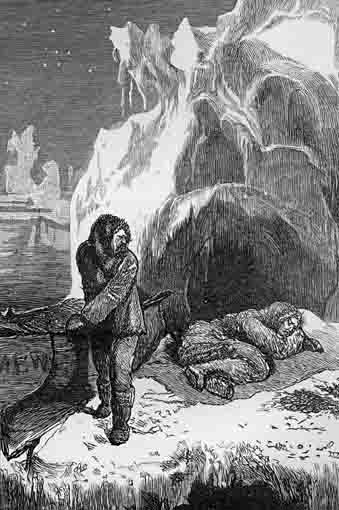
Showing posts with label Hablot Knight Browne. Show all posts

Sunday, 23 December 2012

Book Review: Charles Dickens 15 - "Our Mutual Friend"


Charles Dickens in 1862

After Charles Dickens completed Great Expectations in June, 1861, he moved down to Gad’s Hill Place – his house near Rochester in Kent – for the summer. He spent a lot of time preparing a new series of public readings that had been set for the coming autumn. He wanted to expand his repertoire of material, so he worked up readings from Nicholas Nickelby (“Nicholas Nickleby at Yorkshire Schools”), a short story from his former magazine Household Words (“Mr. Chops, the Dwarf”), Pickwick Papers (“Mr. Bob Sawyer’s Party”), and David Copperfield (“Storm at Yarmouth”).
Dickens used old copies of his magazine instalments of the novels, in order to cut and paste prompt-copies for each reading. He completely revised the book sections that he used. He would choose scenes that were powerfully dramatic, or very funny – removing any references to sub-plots or incidental characters. He would also excise any political or social references; he didn’t think they were appropriate for an event that was strictly “entertainment”. Dickens added stage directions in the margins – reminding himself about the physical gestures and vocal effects he wanted to use, in order to make his presentations more dramatic, more effective.
The autumn tour – his second major public-reading tour of England – ran from late-October to the end of January. It didn’t start well at all. There was less magnetic energy between himself and the audience than Dickens was used to. More importantly, his extremely competent manager, Arthur Smith – who had previously handled every aspect of these events with punctilious care – had suddenly died. His replacement, Arthur Headland, was incompetent – constantly making serious mistakes, which made Dickens mad, because he expected precision about these matters.


Hanover Square Rooms - an engraving from 1843

The following spring, Dickens did another series of readings. He was keen to earn more money, in order to defray the growing expenses he was incurring supporting his family and friends. He also thrived on the applause and adulation he received from his loyal fans. This new season of readings was done in London’s Hanover Square Rooms, instead of being spread around the provinces. Dickens eventually began organising and rehearsing the dramatic and gruesome scene from Oliver Twist which described the murder of Nancy by Bill Sykes. The horror of the scene, and the intensity with which he delivered it, made Dickens think twice about doing it in public. He avoided it for five years; but when he eventually began performing it, he did it constantly, and it proved to be both physically and emotionally exhausting for him.
In June, 1862, Dickens began making regular visits to Condette – a village ten kilometres south of the town of Boulogne, in northern France. The reason for these regular visits – known to only a few of his most intimate friends – was to visit Ellen Ternan. He had set up Ellen and her mother in a small house there. They were close enough – only thirty kilometres south of Calais – to be readily accessible to Dickens, but far enough away to be safe from the prying eyes and ears of London society.

Ellen Ternan
The exact nature of the relationship between Dickens and Ellen Ternan is the subject of much conjecture. Clearly, Dickens was obsessed with this young woman. He pursued her; he financially supported her; and made all sorts of clandestine arrangements so that he could spend time with her – without arousing public suspicion. Claire Tomalin, author of a recent biography of Dickens – Charles Dickens: A Life (2011) – also wrote a book about their relationship, The Invisible Woman: The Story of Nellie Ternan and Charles Dickens (1991). She is virtually certain that they had a sexual relationship, which resulted in a child (who died in early childhood). Other biographers, including Peter Ackroyd, are more cautious. Ackroyd concedes that it is generally assumed that their love was consummated, but he suggests that it is possible that they had a sexless union. He argues that purity and innocence was important to Dickens; and their liaison may have been similar to the love Arthur Clennam felt for Little Dorrit. Dickens would have considered his sexual passion for Ellen as illicit and, therefore, creating a strong sense of guilt. He was, after all, still married to Catherine, although they had been legally separated for about four years (since 1858). He was twenty-seven years older than Ellen, and would have viewed her like one of the young, idealised virgins in his novels. The rumours of an illegitimate child come primarily from Kate, Dickens’s favourite child. She and her brother Henry both claimed, long after their father’s death, that Dickens and Ellen had a son, who died in infancy.
Throughout 1861 and 1862, Dickens had plans to begin work on a new novel – a long novel, like Little Dorrit, that would be published in the familiar format of twenty monthly instalments. He had some ideas, but no clear plot. Things constantly upset any hope for the kind of sustained, settled period he needed to focus on a long campaign of serious writing: there was the constant travelling, the reading tours, several bouts of illness, and family and business obligations – not to mention the weekly chore of editing his magazine, All The Year Round. And, as he grew older, there were more and more deaths of friends and family to throw him off balance. In the second half of 1863, for example, both his mother-in-law, Mrs. Hogarth, and his own mother, Elizabeth Dickens, died. His mother’s death was somewhat of a relief to the family; she had been in a state of mental and physical decline for a long time.


Wood engraving by E.G. Dalziel (1911)

In the late autumn of each year, Dickens exerted a special effort on his magazine’s Christmas edition. This was an important annual source of income for him; the Christmas editions usually sold about 200,000 copies. In the 1863 version, he wrote a Christmas story for the Magazine called “Mrs. Lirriper’s Lodgings”. The portrait he gave of its title character was a fictional tribute to his mother. It was similar to his early work – poignant and very funny. It was one of the most popular things he ever wrote, and that Christmas edition sold over 200,000 copies.


Dickens began thinking about his novel again. He entered into negotiations with the publishers Chapman and Hall about the terms for this new work – his first long novel for seven years. He wanted £6,000 for half of the copyright. And he was given it. He began writing Our Mutual Friend in November, 1863. There were some characters and themes that had been in his mind for several years. He had written notes on a character called Podsnap way back in 1855. He had used the phrase “our mutual friend” three times in Little Dorrit. But, as his first biographer and confidant, John Forster, would recall later, there were three main sources for the foundation of this new novel.

Opening Scene: Jesse Hexam & Lizzie Hexam retrieve a body from the Thames

The first source, Forster wrote, came from wanderings that Dickens had made during the writing of his previous book, Great Expectations. He had been strolling down by the bank of the Thames, when he saw handbills posted, which provided “dreary descriptions” of people who had drowned in the river. This suggested to Dickens the characters of Hexam and Riderhood, the waterside men who made a “ghastly calling” by fishing corpses out of the river at night. “I think,” Dickens had written, “a man, young and perhaps eccentric, feigning to be dead … and for years retaining the singular view of life and character so imparted, would be a good leading incident for a story.” That young man would be John Rokesmith, aka John Harmon.
The second source Forster mentioned were ideas Dickens had for other major characters. He planned to make greed and social position central themes of the book. He had the notion of a man and woman who both married each other primarily for their money, only to discover soon after the wedding that neither of them, in fact, had any money. After finding out their mistake, Dickens recalled, they would “enter into a league and covenant against folks in general.” These would become the Lammles. Dickens also planned to create a couple he thought of as Perfectly New people – what we call today nouveau riche. “Everything new about them,” he wrote, “… new like the furniture and carriages – shining with varnish, and just home from the manufacturers." And these would be the Veneerings; like veneer – all surface, no depth.

Mr. Riah and Jenny Wren

The final thing Forster talks about is Dickens intention to put a benevolent old Jew in his new story – called Mr. Riah, a generous and noble character who works for a villain named Mr. Fledgeby (“Fascination Fledgeby”). Dickens’s motivation was to make amends – long after the fact – for his portrait of Fagin (“the Jew”) in Oliver Twist. In the midst of the monthly run of Oliver Twist – back in 1838 - he had received a letter from a Mrs. Eliza Davis complaining about his characterisation of Fagin. She argued that he “encouraged a vile prejudice against the despised Hebrew”, and that he had done a great wrong to the Jewish people. In a letter back to Mrs. Davis, Dickens replied in some detail that she had misinterpreted his real attitude – that he bore no ill-will or prejudice toward Jews. His immediate response had been rather defensive, but he must have thought long and hard about her opinion, though, because in the final sections of Oliver Twist he drops the constant use of the term “the Jew” – favouring simply the name Fagin. And in Our Mutual Friend, Dickens not only includes the upright and kind Mr. Riah, who works for a nasty ‘Christian’ money lender, he also has Lizzie Hexam working for Jewish employers. When a clergyman expresses concern about her remaining with them, Lizzie says: “I think there cannot be kinder people in the world.”

Dust heap at King's Cross - watercolour from 1837

Another major source for the new book was an article that R. H. Horne had submitted 13 years earlier (13 July, 1850) to Dickens’s former magazine Household Words. The article was titled “Dust; or Ugliness Redeemed”. It was about so-called “dust heaps” – huge piles of residue from coal fires mixed with domestic garbage. Elements of Horne’s attitude towards these heaps – especially the notion of them as places of decay, death and resurrection (the phoenix rising out of the ashes) – would emerge in Dickens’s novel.
By late January of 1864, Dickens had written only the first two monthly issues. He planned to have at least five instalments completed before publication began. That would be a lot more than usual, but he realised that he was not writing as quickly and as easily as he had in the past. He also had anticipations of being regularly interrupted by social events. Posters, handbills and advertisements promoting the book were spread throughout London by the end of April. Its first issue appeared in May.

Front cover of Our Mutual Friend
Our Mutual Friend is Charles Dickens’s fourteenth novel. It was his last complete novel. It was published in nineteen monthly instalments from May 1864 to November 1865 by Chapman and Hall. Each issue, as usual, had 32 pages of text and two illustrations, and cost one shilling. The final instalment was of double-length and was priced at two shillings. The illustrations were not done this time by Hablot Knight Browne (‘Phiz’), but by Marcus Stone. Dickens had fallen out with Browne (who had been his artist-collaborator for about 27 years – since the very first novel, The Pickwick Papers). The problem went back to Dickens’s separation from his wife, Catherine. He had severed his relationship with the publishers Bradbury and Evans because Frederick Evans had had the temerity to criticise Dickens’s behaviour towards his wife. Dickens not only transferred the publication of his novels back to Chapman and Hall, but he also closed up the magazine Household Words – which had been a nine-year partnership with Bradbury and Evans – and started a new periodical called All The Year Round. Dickens had not been best pleased when ‘Phiz’ began doing illustrations for the magazine that Bradbury and Evans had set up as a rival to Dickens’s All The Year Round. So he switched to someone else to illustrate Our Mutual Friend. Hablot Knight Browne was terribly offended. Marcus Stone was not as good as Hablot Browne. He was younger and keener, and certainly more contemporary. But his style was so different: Browne had been vivid and often grotesque, working with steel etchings; Stone favoured wood prints, and his approach was naturalistic and rather sentimental. Dickens had always conferred closely with Browne about which scenes to illustrate, so it was rather odd that he showed a much more casual attitude with this younger, less-experienced artist. He simply invited Marcus Stone to choose his own “good moments” from each month’s instalment. Dickens was getting older. Other non-writing concerns were wearing him down – and there seemed to be a decline in his enthusiasm and concern for the many details of novel-preparation. The first issue of Our Mutual Friend sold about 35,000 copies. Interest in the book waned, however, during its run; by the end of its serialisation, it was only selling about 19,000 copies.
Dickens's working notes for the first section of  Our Mutual Friend

Our Mutual Friend is the final book of Dickens’s so-called London Trilogy – the three late-period books centred on a critique of society in the English capital. Bleak House had fog as its dominating symbol; in Little Dorrit it was the prison. For Our Mutual Friend, Dickens used the gigantic dust heaps – the mounds of coal-fire residue and domestic detritus collected from London’s residents – as the book’s defining image, suggesting rot, ashes, mud, decay, death and resurrection. But he also used water as an important symbol, with the ambivalent notions of life and death being tied up in it – life emerging from it, being dependent on it, and succumbing to it, through drowning. Dickens was focused on a change he sensed in civilisation – the growing attachment to financial speculation, foreign investment, and the idea that the worth of everything lay in its monetary value. The city was now a world primarily of barter and exchange.


Dickens photo from 1865

Dickens’s writing came much slower these days. He found it difficult switching back to monthly instalments, after producing his previous two novels in weekly issues. He said the effort left him “quite dazed”. Dickens’s notes show how he built each new monthly instalment carefully from the last. He planned a more unified structure. His narrative style was a lot more fanciful than usual – similar to what he did in Bleak House.


After the self-revelation of his previous book, Great Expectations, Dickens turned his attention back to a sharp attack on English life. The book is full of derision for English social behaviour. In fact, most of social life in Our Mutual Friend is seen as nothing more than a game, tainted by pretension and false values. Dinners are an empty ritual. Dickens, who had always been a life-of-the-party type, began to hate parties. As he put it, he would invariably “bolt” very early, or, when the time was right, he would “slip away”. This formerly gregarious host had now become primarily a self-contained man. He hated all of the dreadful gossip; and he must have feared inadvertent comments about his wife Catherine and rumours spreading behind his back about his relationship with Ellen Ternan. His general hatred for this social scene shows in the book – his sympathies generally are with the odd characters and the social outcasts. The radicalism of his youth seemed to have erupted in his last novel.

Staplehurst Train Crash of June, 1865

Charles Dickens looked much older than his 53 years. He had aged rapidly during the last few years. His face betrayed the conflicts and anxieties which beset him. And he began to suffer episodes of gout – one of his feet began to swell because of vascular degeneration. And then came a traumatic event that had a major impact on his physical and emotional health. He was coming home from France in June, 1865 with Ellen Ternan and her mother, Mrs. Ternan. They were on the Folkestone-to-London train; and, just before reaching the station at Staplehurst, a signalman mistakenly directed the train to proceed ahead, even though a section of rail had been removed for repairs. The train was going about 50 mph and derailed at a bridge. It jumped a forty-two feet gap in the rail. Seven of the eight first-class carriages plummeted down from the bridge into the riverbed below. Dickens’s carriage was half off the track, but it didn’t fall with the others. He helped get the Ternans out of their carriage, and then he climbed down to assist with the care of the wounded and dying. He spent a long time helping, and witnessed several individuals die of their wounds. And then he clambered back up to his precariously-balanced carriage in order to retrieve the manuscript of his latest monthly instalment of Our Mutual Friend, which he had left in his overcoat pocket. The later inquiry into the accident was a big worry for Dickens; he was anxious that it not be revealed publicly with whom he had been travelling. He managed to have this information kept secret. More important than this immediate anxiety, however, were the long-term physical and psychological effects. From now on, Dickens – who travelled a great deal for both business and private reasons – suffered intense anxieties about travel.
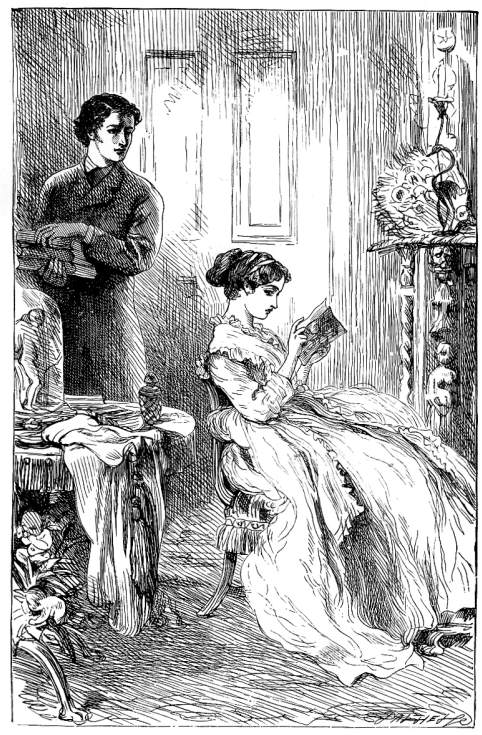
John Rokesmith & Bella Wilfer
By August, Dickens was working on the novel’s final issue – the usual double-number. When he had it finished, he wrote – for the very first time – a Postscript for the novel, in which he justified the narrative method he had adopted in the book, and provided a brief description on the Staplehurst crash. He also mentioned the problems of serialising a novel in monthly sections. It sounded rather defensive – as though the author was anticipating a critical backlash. The response was mixed. One of the worst comments came from the young Henry James, who called the book “the poorest of Mr. Dickens’s work. And it is poor with the poverty not of momentary embarrassment, but a permanent exhaustion.”


Noddy Boffin looks for miser books
Of the three large, late-period novels dubbed the “London Trilogy”, Our Mutual Friend was my least favourite. The plot is an odd contrivance. The mystery of John Harmon’s fate is, strangely, revealed rather early to the reader. And then the change of character that Noddy Boffin goes through – tainted by the money he inherits and the social position it gives him – is later revealed as a sham, and a subterfuge planned with his secretary, Mr. Rokesmith. As G. K. Chesterton points out, in his 1907 introduction to the Everyman Edition, the original change of attitude seems to be Dickens’s original intention – another example of the corruption brought by money – but then altered later because of difficulties that Dickens had resolving the plot in the limited space he had available.
The portraits of the various social hypocrites that make up the circle of self-centred acquaintances that meet for dinners throughout the book – the Veneerings, the Lammles, the Podsnaps – are intitially of interest for the broad, satirical swipe Dickens aims at them. This is the social realism that Dickens aimed for in this book. But they don’t do much of interest, and they don’t advance the main plot. Mr. Podsnap – whom Peter Ackroyd identifies as a less-than-subtle portrait of Dickens most intimate friend and business advisor John Forster – serves as a representative of that disdainful society which condemns the relationship between Eugene Wrayburn – “one of their own” – and the low-born Lizzie Hexam - daughter of the apparently disreputable waterside man Jesse Hexam. Silas Wegg, who enters the story as a “balladmonger” and the keeper of a very small fruit-stall, is intended by Dickens to be one of his larger-than-life comic rogues. I found him actually to be quite tiresome, and the extended scenes between him and his taxidermist friend Mr. Venus seemed to drag on with little import or entertainment.

Bradley Headstone and Roger Riderhood

Of much more interest in this book are several of the female characters – and the love-interests they provoke. Bella Wilfer is the woman whom John Harmon was supposed to marry upon his return to England, in order that they both benefit from the will of the wealthy Mr. Harmon. She enters the story as a self-regarding and rather shallow person, but as the story progresses, she develops into an admirable character with whom, sure enough, John Harmon falls in love, regardless of any financial consideration. She has a close, rather flirty relationship with her father. Lizzie Hexam is one of those Dickens innocents who spend most of her time trying to protect her virtue. She is attracted to the high-born Eugene Wrayburn, but also runs from him, fearful that he is only interested in using her for his own satisfaction. She later heroically saves his life – using her skill as a boater to pull his battered body from the river Thames. She is also pursued by the schoolmaster Bradley Headstone, who is so obsessed with her that he attempts to kill her upper-class admirer. Headstone is an interesting character – one of those fevered criminal minds that Dickens puts us inside. And then there is Fanny Cleaver (“Jenny Wren”), a crippled young woman, who has successfully established a small business as a dolls’ dressmaker. She is linked to Mr. Riah, the noble and kind employee of the nasty Mt. Fledgeby. Jenny is another of those interesting characters who are physically weak, but actually very strong emotionally.


In Our Mutual Friend, London is an ugly and corrupt place. It’s a scene of moral and physical degradation – fog, rain, mud, decay, and death. It’s still the prison environment of Little Dorrit, a sad and depressing place. Is it any wonder that Dickens spent most of his time now either at Gad’s Hill Place in Kent, or near Boulogne in France. At the conclusion of Our Mutual Friend – which would turn out to be his last complete novel, Dickens was already thinking about his next book. And that one would be set again in the Rochester area – the milieu of Great Expectations – the scene that had inspired him to create a much more popular and successful novel.


[2012 is the bicentenary of the birth of Charles Dickens. Lots of special events and activities are planned in England this year. Back in 2009, my good friend Tony Grant (in Wimbledon, UK) and I did a pilgrimage to three key Charles Dickens destinations - his birthplace in Portsmouth (the house is a Museum), the house he lived at on Doughty Street in London (now the chief Dickens' museum), and the town he lived in as a child on the north-coast of Kent (Rochester). 

These visits inspired me to begin reading through all Dickens's novels. By last summer I had done six, but stalled in the middle of Dombey and Son. I thought what I could do to mark this special year of Dickens was to start again, read through all of his novels inside the year, and blog about them. So this is the fifteenth of a series.]

Next: The Mystery of Edwin Drood

[Resources used: "Introduction" to Our Mutual Friend by Andrew Sanders (1994); Dickens by Peter Ackroyd (1990); Charles Dickens: A Life by Claire Tomalin (2011); "Portraits of Charles Dickens (1812-1870)", an excellent web-page collection of Dickens pictures.  Dickens Portraits ]


Tuesday, 11 December 2012

Book Review: Charles Dickens 13 - "A Tale of Two Cities"


Photo of Dickens (46 yrs.) by G. H. Watkins (1858)
The origin of A Tale of Two Cities – Charles Dickens’s famous novel set during the French Revolution – goes back ultimately to Thomas Carlyle’s influential book The French Revolution: A History, which was published in 1837, when Dickens was 25 years old. Dickens became obsessed with the book, and he read it hundreds and hundreds of times. He eventually met Carlyle and they became friends – the Scottish author came to see some of Dickens’s amateur theatricals, and he sometimes offered praise and critiques of the younger writer’s novels. When Dickens was writing A Tale of Two Cities through most of 1859, he carried Carlyle’s book around with him all the time – there is a photograph of Dickens that shows him reading it in the garden at Gad’s Hill Place.

Of more immediate influence on A Tale of Two Cities were two plays: The Frozen Deep by Wilkie Collins, and The Dead Heart by Watts Phillips. Dickens had long been fascinated by accounts of the doomed Arctic voyage of the John Franklin expedition. In 1845 Franklin had attempted to find a way through the last un-navigated section of the Northwest Passage. Dickens had written several articles about the expedition for his magazine Household Words. When Wilkie Collins and Dickens were visiting Paris together in early 1856, Dickens persuaded his friend (primarily a novelist) to write a play based on the Franklin expedition that could be presented at the next Dickens family Twelfth Night celebration at Tavistock House. Although Collins wrote the drama, Dickens was constantly giving him advice; and later he heavily revised it and added some scenes of his own. And, as usual, Dickens took charge of virtually every aspect of the production.
Poster for Twelfth Night play at Dickens's home
The Frozen Deep turned out to be a melodrama concerning the rivalry between two members of the expedition for the same woman. Wilkie Collins played the part of the expedition leader, the successful suitor; and Dickens acted the part of Richard Wardour, who had been rejected. Wardour is presented as an ambivalent character who is motivated both by love and anger. But at the conclusion of the play, Wardour sacrifices himself, in order to save the life of his rival. Dickens revised and edited his part – creating a good man whose heart and soul had been frozen by his loss of love. As Peter Ackroyd points out in his biography, the character of Wardour became a “self-revelation” for Dickens. He had always shown great ability as an actor in previous amateur theatricals, but this time his identification with the part was intense. There had often been a rather histrionic tendency in his approach to drama, but eyewitness accounts described an even more extraordinary frenzy in his acting. A review in The Leader noted the “savage energy” in his performance.

In addition to the Twelfth Night production on 6 January, Dickens’s amateur troupe gave three more performances that week - about 90 people were present for each. After the intensity of this week of performances, Dickens and Wilkie Collins took a break from work for a few days down in Brighton. During their stay on the south coast, Dickens’s friend Benjamin Webster – the actor and dramatist who ran the Adelphi Theatre in London – read to him the manuscript of a new play by Watts Phillips called The Dead Heart. It was also a story of self-sacrifice – set this time in Paris during the French Revolution, rather than the frozen Arctic. At the dramatic conclusion of this play, there is a surreptitious substitution at the guillotine.

Scene from The Frozen Deep
Six months later a special benefit performance of The Frozen Deep was mounted, in order to raise money for the family of the recently-deceased Douglas Jerrold. Jerrold – a playwright and journalist – had been a friend of Dickens for twenty years. The benefit took place on 4 July at the Gallery of Illustration in Regent Street. Queen Victoria was in attendance. Dickens had planned to raise an even £2,000 for the Jerrold family, but they fell short of the target. When he was invited by a promoter in Manchester to give several performances at the New Free Trade Hall, Dickens seized the chance to make up the shortfall.

When Dickens went north to check out the facilities in Manchester, he realised that the hall was much too large for some of his amateur actors to cope with. They just didn’t have the training to project their voices into a hall designed to hold 2,000 people. Dickens decided to hire some professional actors who could handle these new demands. And that is how Charles Dickens met the actress Ellen Ternan. He invited the entire Ternan family to participate – Mrs. Ternan and her three acting daughters: Fanny, Maria and Ellen. They were all experienced actors and had been on the stage of many of London’s top theatres.


Ellen Ternan

Ellen Ternan was just eighteen when she performed in The Frozen Deep in Manchester. According to an intimate of the Ternan family, Ellen was “outwardly placid, but firm underneath”. Dickens’s second daughter, Kate, remembered her as “small, fair-haired, and rather pretty”. “She had brains,” Kate thought, but she was actually the least talented of the three acting sisters – pushed into acting because that was what the family did (she first stepped onto the stage when she was three years old), rather than responding to a sense of vocation. Dickens became enthralled by the teenaged actress. He was forty-five years old, married, with nine children. But he seemed drawn inexorably to this attractive young woman. It was a classic mid-life crisis. Like the male protagonist of his recent novel Little Dorrit – Arthur Clennam – Dickens’s attraction to this unattainable woman was probably intensified by his sense that life’s possibilities were slipping away from him, and by his unhappy marriage with Catherine.
Meanwhile, the two performances in Manchester were such a triumph that Dickens agreed to add an extra show. And it was as he lay “dying” on the stage as the self-sacrificing Richard Wardour – near the play’s conclusion on this final night – that Dickens conceived the basic idea for A Tale of Two Cities.

1935 Hollywood version of A Tale of Two Cities - directed by Jack Conway, starring Ronald Colman

Dickens began a long, desperate pursuit of Ellen Ternan – but he had to do it discreetly, in order to protect both her reputation and his public image. He began to express what he was going through to some of his closest confidants. “Poor Catherine and I are not made for each other,” he wrote to John Forster. He turned away demonstrably from his wife in October, 1857. He instructed the maid to divide the main bedroom at Tavistock House into two rooms, by setting up a partition. He was so agitated at this time that one night he got up at 2 a.m. and walked 30 miles through the night from Tavistock House in central London to Gad’s Hill Place in Kent.
At Christmas in 1857, there was no large family party because of the turmoil in the house. But Dickens did do some more public readings. He had given a powerful speech on behalf of the Hospital for Sick Children – it helped to raise £3,000. A few weeks later he did yet another public reading of A Christmas Carol for the same benefit fund, and finally the hospital was effectively endowed for the very first time. The power of these performances led Dickens to consider these public readings as an alternate source of income. He realised that if he undertook an extended tour around the country, he could raise some badly-needed funds to stabilise his own financial situation. There was, in fact, already a tradition of writers giving public presentations – more often lectures, though, than readings. They were undertaken both as educational activities and high forms of entertainment. He did a dry run in Edinburgh to see if the public would support his readings as paid entertainment, rather than charitable activities. It was a resounding success. His first non-benefit, paid public reading was at St. Mary’s Hall in London. It was the beginning of a twelve-year run of public readings that would continue until the end of his life.

Dickens doing a public reading - a wood engraving by Charles Barry (1867)

In the early months of 1858 Dickens was still deeply estranged from his wife Catherine. In May he finally undertook to establish an informal separation between them. He wanted the whole thing to be discreet, of course, so that there would be no damage to his public reputation. To justify his actions, and to divert any possible suspicions about his growing relationship with Ellen Ternan, he began making some rather disgraceful comments about Catherine in letters to his friends. To Angela Burdett-Coutts, for example, he wrote of his wife: “She has never attached one of them [their children] to herself, never played with them in their infancy, never attracted their confidence as they grew older, never presented herself before them in the aspect of a mother.” This just wasn’t true, but Dickens really seemed to believe it. It was another example of how his imagination always seemed to trump reality.
Dickens’s friends John Forster and Mark Lemon arranged the original separation with Catherine. Her mother, Mrs. Hogarth, attempted to draw up a deed of separation. And then things started to unravel. The Hogarths were threatening to sue Dickens in the Divorce Court – precisely what he was intent on avoiding. A legal settlement was quickly arranged: Catherine would get an annual income of £600; and she would have unlimited access to the couple’s children – as long as there were no lawsuits pursued by either of them against the other. Inevitably, when news of the legal separation emerged, rumours began to circulate about Dickens’s relationship with Ellen Ternan. Foolishly – instead of ignoring the gossip – Dickens got on his high-horse and published a statement in The Times denying that there was any improprieties in his friendship with Ternan. A classic example of “the man doth protest too much.” The public statement did not eliminate the gossip, of course – it encouraged it. The whole affair (pun intended) damaged his reputation and estranged him from many former friends and colleagues. To avoid facing this sort of public scrutiny, Dickens began going down to Gad’s Hill Place regularly in July.


Painting of Dickens by William Powell Frith (1859)
In the New Year of 1859, Charles Dickens sat for a portrait by William Powell Frith. It was commissioned by his closest friend, John Forster. The painting showed Dickens at home in his study. He is wearing a velvet jacket and posed on a chair, in front of his desk. Although the detail cannot be discerned in the painting, the paper propped up on the desk is the opening chapter from his new novel, A Tale of Two Cities. Forster loved the painting; Dickens, as usual, was not fully satisfied. He said his facial expression was that of a man who had just heard that a misfortune had befallen an unfriendly neighbour! To help capture the author’s features, Frith had made use of a photograph of Dickens taken by George Herbert Watkins, a well-known professional photographer, who had done a series of photographs the previous year in his studio on Regent Street. [One of those pictures is seen at the top of this review.] The painting and the photographs revealed a serious man, looking tired after the struggles of a difficult year.


Home of All The Year Round on Wellington St.
One of the major casualties that occurred because of Dickens’s separation from his wife was his relationship with Frederick Evans – one-half of his publishing firm of Bradbury and Evans. Dickens was very upset at Evans’s critical attitude towards him. So he decided to cut his ties with them both. Negotiations began about the copyright to the novels (they had published the previous five) and the fate of the weekly magazine Household Words, which had had a run of nine years. Dickens bought out the rights to it for £3, 550. He determined to set up a new magazine as quickly as possible. It would be called All The Year Round, and would be set up in an office on Wellington Street.


Cover of the first issue of All The Year Round
 Dickens realised that he needed to establish his brand new magazine immediately by jumping straight into a new novel. He still had the rough notes he had written following that episode on the stage in Manchester (when he had been “dying” as Richard Wardour). He soon had a title – A Tale of Two Cities. It was going to be published first as weekly instalments in All The Year Round; and then bound up monthly in the familiar green-covered wrappers. The new weekly was going to look identical to Household Words – with the same size, the same page-format (with two columns), the same drab look (no illustrations), and roughly the same number of articles. He planned for the magazine to include serialised novels, short stories, and topical articles. It would also cost twopence. But, finally, for the very first time, Dickens would have complete control of his periodical; he would be editor and publisher. And his very competent friend, William Henry Wills, would continue to serve as sub-editor. Dickens advertised his new weekly with newspaper ads, handbills, placards and billboards. Because of the tremendous success of A Tale of Two Cities, sales of All The Year Round would never drop below 100,000 copies – amazing, really, given that Household Words had been selling about 35,000 – 40,000 copies.


First monthly binding of A Tale of Two Cities
 The first issue of Dickens’s new weekly, All The Year Round, was released on 30 April, 1859. Dickens had had to work very quickly to get his novel on track for that date. As usual, he wanted to have a head-start on the story, in case any personal or professional problems interfered with his writing. So, when the first edition hit the shops in London, Dickens already had the first three episodes completed. A Tale of Two Cities ran as thirty weekly parts from 30 April until 26 November, 1859. To print his magazine, Dickens went back to his former publishers Chapman and Hall. The illustrations were done by his familiar collaborator, Hablot Knight Browne (‘Phiz’). But Dickens’s relationship with the artist cooled, when Phiz agreed to work on Bradbury and Evans Once A Week – a new magazine set up as a rival to Dickens’s All The Year Round. A Tale of Two Cities would be the last book that Phiz would work on with Boz (Dickens). They had been working together now for 22 years – their first collaboration going all the way back to Dickens’s first novel, Pickwick Papers.


Once Dickens got going on his novel, the writing came fairly easily. As mentioned earlier, Dickens had read Thomas Carlyle’s history of the French Revolution many, many times – in a letter once he claimed to have read it 500 times. Even so, he was keen to get other perspectives and further details of the period. He contacted Carlyle and asked him to recommend some books on the topic. Dickens reported that his friend sent along a couple of “cartloads” of books from his own private library in his home on Cheyne Walk; and he read, or skimmed, most of them. Carlyle came to see Dickens do one of his public readings. He laughed vigorously throughout. When he went backstage after the performance to offer his compliments, he told Dickens, “Charley, you carry a whole company of actors under your hat.” When A Tale of Two Cities was first released in book form, Dickens dedicated it to Carlyle in gratitude for his “wonderful book”, his history of the Revolution.

"The Storming of the Bastille" - a painting by Jean-Pierre Houël (1789)
By the middle of May, Dickens was a complete “slave” to the new novel. He moved down to his house at Gad’s Hill Place in Kent for the entire summer of 1859, in order to work steadily on it. He set up a new routine. He wrote for his usual four or five hours per day from Wednesday to Monday; then he would travel to London on Monday afternoon, in order to work at the All The Year Round office all day Tuesday – returning to Kent on Tuesday evening. His focus on the novel was so intense that he finished it by early October, almost two months ahead of its final weekly instalment. Unlike most of his books, A Tale of Two Cities was built on story and incident, rather than character and dialogue – it was the momentum of its dramatic story that constantly propelled him forward.

1958 British film production of A Tale of Two Cities - directed by Ralph Thomas, starring Dirk Bogarde
Dickens’s attitude to the French Revolution was typical of the English liberal of the day. He believed that the oppression of the aristocracy – the ancien régime – had established the conditions which pushed the peasants into revolt. Back in the mid 1840s, Dickens had written in The Examiner magazine that the revolution “was a struggle on the part of the people for social recognition and existence.” A philosophy of freedom and equality had overthrown a feudal despotism. During the immediate aftermath of the rebellion, Romantic writers in England had celebrated its early effects. Wordsworth, for example, had famously declared of those heady days: “Bliss was it in that dawn to be alive; but to be young was very heaven!” But then came Robespierre and the brutal excesses of the Terror. Dickens’s book would reflect this ambivalent response to the Revolution – condemnation of the old order, but horror at the virulence of the later violence.

"The Sea Rises" by 'Phiz' (1859)

A Tale of Two Cities is a historical novel, only the second of Dickens’s career – the first had been Barnaby Rudge, a book focused on the anti-Catholic riots of 1780 in London. Barnaby Rudge had been a much more discursive book – typical of his early works, which were usually issued in monthly parts. The novels written in weekly parts were not as flabby – they usually contained a smaller cast of characters, and had a more direct story, with fewer sub-plots. A Tale of Two Cities fits that mold. It is straightforward, fast-paced, and tense – the excitement of the plot pushes the story forward. What Dickens does is quite brilliant – he compresses the entire, complex history of the Revolution into the story of a single family. Dickens selects several key moments in the Revolution, and shows how they affect the Manette family. Public history becomes private history. He creates vivid and dramatic scenes that embody different aspects of the conflict: the assassination of the cruel Marquis St. Evrémonde, for example, and the storming of the Bastille. As Simon Schama points out, Dickens also creates dramatic moments which not only illustrate a theme, but also suggest a ritualistic, or prophetic, quality. When a barrel of red wine smashes to the ground in the impoverished Parisian district of Saint Antoine, the residents clamber over to the puddles and riverlets, in order to slurp up the precious liquid. The scene emphasises the poverty of the city’s inhabitants, but the red stains all over the people’s hands, chins, and clothing, foreshadow the bloodshed that is to come.
Coach of Marquis De Evrémonde runs down and kills a small child in a Parisian street

There are a lot of dialectics in this novel, a lot of twinning (“best of times, worst of times”): the trial at the Old Baily in London, in the early part of the novel, is balanced by the later trial in Paris, in front of the revolutionary tribunal; the sweet innocence of Lucie Manette is countered by the evil machinations of Madame Defarge; the active intentions of the self-sacrificing Sydney Carton balanced by the passive disinterest of Charles Darnay. There are the twin themes of life and death: characters recalled to life and earning their redemption, whilst others condemn themselves to death and destruction. There are also the twin themes of present and past – how memory links one to the other, and, can lead either to vengeance or reconciliation.

"The Likeness" - lawyer Sydney Carton faces defendant Charles Darnay at the Old Bailey by 'Phiz' (1859)

And then there are the private demons underpinning Dickens’s passionate approach to the novel. The self-sacrifice of the cynical lawyer Sydney Carton echoes the self-sacrificing character of Richard Wardour in Collins’s play The Frozen Deep. Dickens is surely projecting his own feelings and yearnings into these two figures. And it’s not hard to see that Lucie Manette must have been inspired by Dickens’s infatuation with Ellen Ternan. As Dickens is writing this book, she is still the innocent and unattainable ideal of womanhood. And going back to the twining theme in the previous paragraph, Sydney Carton and Charles Darnay might be seen as a doppelgänger reflecting Dickens’s twin-nature at this time. As Charles Darnay (same initials as Dickens!), he is the successful suitor of the innocent young woman, but disinterested and rather misunderstood; as Sydney Carton he is the troubled, unrequited, self-mocking ironist who sacrifices his life for the unattainable woman that he loves.

An out-door production of A Tale of Two Cities by the Dickensian Tabard Players
at The George Inn in Southwark (1949)

A Tale of Two Cities, of all Dickens’s mature work, has always opened the widest gap in appreciation between critics and readers. The general public has always loved the book – it is one of the author’s most popular novels. Literary critics, until more recently, have rarely given the book its due. They tend to offer lukewarm equivocations: it is called “uneven”, “clumsy”, and “melodramatic”. It certainly doesn’t have the complex density of a book like Bleak House. But it does have several intertwining motifs that serve as potent symbols or metaphors – without slowing down the accelerating momentum of the plot. A Tale of Two Cities is undoubtedly the most dramatic of Dickens’s novels. So dramatic, in fact, that it was very soon adapted for the London stage,  adapted by Tom Taylor for the Lyceum Theatre, although – truth be told – it was Dickens who pretty much directed the production.
A Tale of Two Cities is not a difficult read. In some ways, it’s actually rather accessible: a comparatively short book (by Dickens’s standard!), a story of romantic longing, with an uplifting and melodramatic ending. A real page-turner. If you wanted to introduce a young reader to the marvels of Dickens, this – or perhaps Oliver Twist – might be the place to start. But it is also a rather dark work – crammed with images of horror and destruction, and scenes of disease, dirt, poverty, imprisonment and execution. The mood overall is one of fatigue, decay and despondency – reflecting, perhaps, Dickens’s emotional turmoil. Here was a man, in some ways, in anticipation of death, but still clinging to the hope of a new love, a new redemption – a man desperate to be recalled to life.


"Congratulations" - Charles Darnay is acquited, thanks to the ruse of Sydney Carton  by 'Phiz' (1859)
[2012 is the bicentenary of the birth of Charles Dickens. Lots of special events and activities are planned in England this year. Back in 2009, my good friend Tony Grant (in Wimbledon, UK) and I did a pilgrimage to three key Charles Dickens destinations - his birthplace in Portsmouth (the house is a Museum), the house he lived at on Doughty Street in London (now the chief Dickens' museum), and the town he lived in as a child on the north-coast of Kent (Rochester). 

These visits inspired me to begin reading through all Dickens's novels. By last summer I had done six, but stalled in the middle of Dombey and Son. I thought what I could do to mark this special year of Dickens was to start again, read through all of his novels inside the year, and blog about them. So this is the thirteenth of a series.]

Next: Great Expectations
[Resources used: "Introduction" to A Tale of Two Cities by Simon Schama (1990); Dickens by Peter Ackroyd (1990); "Portraits of Charles Dickens (1812-1870)", an excellent web-page collection of Dickens pictures.  Dickens Portraits ]

Sunday, 18 November 2012

Book Review: Charles Dickens 12 - "Little Dorrit"


Dickens portrait by Ary Scheffer (Nov. 1855)
Despite all of the success and adulation he continued to receive for his literary work and his public activities, and despite the personal satisfaction he got from his artistic growth as an increasingly serious novelist, Charles Dickens at this time was not a happy man. Something fundamental was gnawing at his gut. He felt trapped by his past – caught in a troubling vision of his life that kept coming back to haunt him. And he was growing ever more dissatisfied with his domestic situation – unhappy with his wife and bothered by constant problems with his children and his siblings.
Dickens had finished Hard Times in August, 1854. He took a year off before getting started on his next novel. During that year-long hiatus from serious writing, he continued with the same kinds of activities that he’d been involved with for the last few years: producing his weekly magazine, Household Words, planning amateur theatricals involving family and friends, doing public readings for charity, and making regular trips back-and-forth to France.
Dickens was back in England in December, 1854, from a holiday in France, in order to prepare for his second round of Christmas-time public readings, undertaken again to benefit several charities that he supported. The use of privately-organised foundations and institutions to support charitable enterprises was very important during the Victorian era, and most public figures engaged in activities designed to help the poor and disadvantaged. Dickens had inaugurated public readings from his books during the Christmas season of the previous year – and that first experience had been a resounding success. On December 19 of this year he did a performance in Reading for the Literary, Scientific and Mechanics Institution; two days later he was in Sherborne on behalf of the Literary Institute there; and, just after Christmas, he was up north in Bradford for the Temperance Educational Institution, doing a reading in front of 3,700 people at St. George’s Hall. Since these were all done during Christmas time, Dickens used A Christmas Carol for all three readings.
One innovation of this season’s readings was an invitation to the audience from Dickens to respond freely to his work – whether with tears of sorrow, or shouts of laughter. They should not feel inhibited by the formal situation, he told them. The audiences would erupt into applause when he made this announcement. And they certainly took him at his word, much to Dickens’s delight – he loved the immediacy of the feedback, and the readings became more dramatic and theatrical as time went on.


The brothers - William and Frederick Dorrit in the Marshalsea Prison yard
Also during December, Dickens was busy organising the annual Twelfth Night play for his family at their London home, Tavistock House. This year he produced a version of Fortunio and his Seven Gifted Servants a fairy-tale play written in 1843 by J. R. Planché. His friend, writer Wilkie Collins, participated as an actor in the performance. More amateur theatricals came in May, 1855. Dickens had just begun work on the first chapter of the new novel, but it wasn’t going well. He abruptly postponed further work on the book and threw his full effort into a new theatrical production – a sentimental melodrama written by his close-friend Wilkie Collins called The Lighthouse. Among the cast were some of his loyal accomplices: the playwright Mark Lemon, the artist Augustus Egg, and the play’s author, Wilkie Collins.
In the New Year of 1855, the American novelist Nathaniel Hawthorne visited England. He made note of the current critical opinions of Dickens that he read in the press. The general public may still have adored him – especially his lower-class and middle-class readers – but he was not to the taste of the literati. They generally preferred William Thackeray, author of Vanity Fair (1848). Blackwood’s Magazine pointed out sniffily that “it is the air and breath of middle-class respectability which fills the books of Mr. Dickens.” And the novelist Anthony Trollope – only three years younger than Dickens, but very early into his own writing career, at this time – dubbed him “Mr. Popular Sentiment”.

At the beginning of February, Dickens noticed that Gad’s Hill Place was for sale. This was the house that his father, John Dickens, had pointed out to Charles, when he was still a small boy. They had walked by the place together when the Dickens family were living nearby (close to Rochester). Dickens’s father had told Charles that it was the sort of reward that might come to a man of success. He had passed the place often during walks between Rochester and London – and always remembered what his father had said. He remarked to his colleague W. H. Wills – his editorial assistant on Household Words – that “the spot and the very house are literally ‘a dream of my childhood’.” He made some enquiries. It wasn’t actually a particularly impressive house – nowhere near as grand, for example, as his current London home at Tavistock House. It was what it stood for that fired his imagination. He made plans to visit and examine the house just three days after his initial enquiry.

Dickens's love in his late-teens, Maria Beadnell
But he got side-tracked from that plan by another dramatic memory of his past. Out of the blue he received a letter from Maria Beadnell – the young woman he had courted back in his late teens, when he was working as a parliamentary reporter. He had been infatuated by her, but she eventually rejected him. Dickens had been deeply humiliated by the rebuff – he thought it was caused primarily by his lack of social position. Maria’s letter was a message of fond reminiscence to her former suitor – now a famous author. Dickens was surprised – and strangely moved – by this unexpected communication. He described his response as a “softened emotion” caused by thoughts of his ardent youth – and a realisation that the wound she had caused him was now buried deep in the past. The more he thought about her, the more impassioned he became. He exchanged a couple of discreet messages with her from London. But soon he was back in Paris again, and from there he sent her a series of lengthier, and more intense, messages. It seems evident, in hindsight, that Dickens behaviour was driven by a deep unhappiness, an intense dissatisfaction with his wife Catherine. He arranged a clandestine meeting with Maria. As soon as they met, after so many years without seeing each other, all his romantic longing evaporated. The youthful beauty of Dickens’s memory was long gone. As Georgina, Dickens’s sister-in-law, bluntly put it later, “She had become very fat and quite commonplace.” As often happened with Dickens, the reality did not match his imaginative vision. He broke off contact with Maria as quickly as he could decently manage it. But only a few months later, Dickens revisited this disappointing experience by introducing a character into his new novel based on Maria Beadnell. Her name was Flora Finching; and she is depicted as an affected, loquacious, sentimental fool. Recalling his own disappointment, Dickens describes the very first encounter that his middle-aged protagonist, Arthur Clennam, has – after twenty-odd years – with  his former sweetheart, Flora: “Clennam’s eyes no sooner fell upon the subject of his old passion, than it shivered and broke to pieces.” Although he softens the portrait of Flora (Maria) later in the book, it is clear that the shock he felt about the discrepancy between his imagination and the reality pushed him to respond cruelly. He must have known she would read his latest book – especially after their recent rendezvous; but as was often the case with him, he only really cared about his own attitudes and needs. Given that, however, Dickens does make her one of the few positive characters in the book, and the reader cannot help delighting in many of her astonishing monologues.


Gad's Hill Place near Rochester (a photo of mine from a visit in 2009)

Later that year, in November 1855, Dickens decided to buy Gad’s Hill Place. He had finally seen it in detail a few months before. He paid £1,790 for it – paying by check on a Friday (his lucky day, he said). He thought of it initially as an investment – he planned to continue living in Tavistock House in London – and intended to rent it out.
Dickens had begun Little Dorrit in May, but when he found the going difficult, he put the work aside to concentrate on amateur theatricals. His friend and confidant, John Forster, thought that Dickens was experiencing “a drop in invention”; but the key problem, as usual, was finding a leading theme for the novel – what he called a “guiding idea”. And then he had it: a group of travellers would meet in the port of Marseilles, France; they are held in quarantine there for some time, and then move on to pursue their own lives. The story would show future connections amongst the travellers. Some of them are soon back in London. One of them meets Amy Dorrit, ‘Little Dorrit’, and discovers that she and her family live in the Marshalsea Debtors’ Prison.
But Dickens was still not sure exactly where this story was going. It certainly wasn’t as carefully planned out and structured as some of his more recent works. The second number of the serialised novel took him three months to complete. His work was interrupted further by his sitting for portraits by Paris-based artist Ary Scheffer and his brother Henri. [Ary’s portrait is featured at the beginning of this review]. Dickens sat for these portraits simultaneously during November. He found the whole process very tedious, and to top it off, as he wrote to John Forster, “I do not discern the slightest resemblance, either in his portrait [Ary’s] or his brother’s”. Finally, at the beginning of December, the first monthly issue of Little Dorrit was published. His publishers, Bradbury and Evans, mounted a big publicity campaign: they put up 4,000 posters around the city; and they printed an incredible 300,000 handbills! Dickens described the response to the first instalment as “a brilliant triumph”. The print run was increased for the next issue to 35,000 copies.


Wrapper of first instalment (Dec. 1855)
Little Dorrit was published, as usual, in nineteen monthly instalments (the last being a double-issue, sections XIX and XX) between December, 1855 and June, 1857. It was divided into two Books – “Poverty” and “Riches”. It was a neat division: the first half dealt with the Dorrits’ life cooped up in the Marshalsea Prison; the second followed their exploits after being release from the prison. This was Dickens’s fifth novel published by Bradbury and Evans – he had been with them now for just over a decade. The new book was illustrated, as usual, by Hablot Knight Browne (‘Phiz’). Each issue was priced at a shilling – except for the last, which, as a double issue, cost two shillings.

As was often the case with Dickens, certain topical events were picked up and used in his new novel. The satirical chapters aimed at government bureaucracy (the ‘Circumlocution Office’ represents HM Treasury) reflected his disgust with the appalling incompetence with which the government was running the Crimean War. Thousands of soldiers were dying of disease and malnutrition because of the lack of supplies, the lack of medical facilities, and the lack of clothing that could protect the troops from the extreme cold. He saw this calamity as another example of the failure of the system – exposing again the callous stupidity of the political aristocracy running the country. He hated Parliament; it was a glaring emblem of the current failure of representative government. Another contemporary event that caught his imagination was a dramatic bankruptcy that rocked the financial system in London. A prominent financier – John Sadleir – committed suicide near Jack Straw’s Tavern on Hampstead Heath, after a long series of financial improprieties. For Dickens, this incident was further proof of the corruption of the entire financial system. He introduced this theme into Little Dorrit in the figure of Mr. Merdle, a popular and socially-prominent financier, who – it turns out – is running a type of Ponzi-scheme.
Dickens’s constant trips back-and-forth to France (usually Paris and Boulogne) indicate his growing disenchantment with London. It was no longer his city. He would soon move permanently to Gad’s Hill Place in Kent. He noticed the physical ugliness of the city more and more. And he felt oppressed by the corruption he sensed at all levels of its society. Little Dorrit is a sustained attack against the current state of English society – its government, its legal system, its bureaucracy, its financial system, and its aristocracy. Dickens also seemed to be avoiding London because of a growing dissatisfaction with his wife Catherine. In May, 1856, for example, when he came back to England from yet another visit to France, he stayed for four days at the Ship Inn in Dover, rather than return immediately to the family home at Tavistock House. His wife’s family (the Hogarths) were staying there and he just didn’t want to deal with them. And in many ways it was Catherine’s sister, Georgina – who had come to live with the Dickens tribe in 1841 as a fifteen year-old, in order to help raise the children – who now ran the household, because of her sister’s physical frailty and diffident attitude.

Looking north at the original wall of the Marshalsea Prison (my photo from a 2012 visit)
The key symbol and dominant theme of Little Dorrit is the prison. The book’s opening chapter is set in a prison in Marseilles, with two characters (one French, one Italian) who quickly drop out of the story, only to return later on. Also in Marseilles are a group of travellers being held in quarantine. And, then, back in London we meet the Dorrit family, who have been living for twenty-odd years in the Marshalsea Debtors’ Prison. Some characters are physically incarcerated. But there are many more characters in this book who have imprisoned themselves: they are constrained materially; they are trapped psychologically; they are restrained emotionally. They are invariably caught in a web of their own making.
And this theme of imprisonment surely reflects Dickens’s own life. He felt trapped in an increasingly unhappy marriage, and trapped in a life dominated by a whole host of family and professional obligations. He was also helplessly trapped in thoughts of the past – prompted especially by Maria Beadnell and Gad’s Hill Place. But were these memories a form of escape, or another kind of mental constraint? Two versions of the situation Dickens found himself in can be seen in the two innocent protagonists of the novel – Amy Dorrit and Arthur Clennam. Arthur is an unhappy middle-aged gentleman who feels that his life is already pretty much over. His emotional-life has been severely scarred by an unhappy childhood that was dominated by a cruel mother. He is a good man, but trapped by emotional constraint – still influenced by his mother’s tyrannical Calvinism. Arthur Clennam is something new in a Dickensian protagonist. Dickens’s ‘heroes’ are usually rather insipid ciphers; but Clennam is a more complicated man. He is self-critical and reflective – someone who has been buffeted by life, and who knows it. It’s hard not to see that this is Dickens pondering his own disappointments. And Clennam is the dominant point-of-view for the novel’s narrative arc. Amy Dorrit is also an innocent character. She may be imprisoned physically in the Marshalsea, but she is seemingly free of psychological and emotional damage. She represents a kind of perfect Christian religiosity – untouched by the degradation and corruption around her. If Arthur Clennam suggests Dickens’s own current, middle-aged plight, then Little Dorrit represents another ideal version of Dickens’s ‘innocent’ childhood. But, of course, he, unlike Amy, was deeply affected – fatally warped – by his brush with the debtors’ prison.

Northern wall of the Marshalsea  - all that's left of the entire prison (my photo from a visit in 2012)
At the time Dickens was writing Little Dorrit, the Marshalsea Prison had not been in operation for some thirteen years. It was closed in 1842 – all of the inmates were moved to other locations on November 19. Curiously, Dickens did not visit the site of the prison, located on the south side of the Thames in Southwark, whilst he was writing about it. He preferred to rely on his memories and his imagination. But just before the long novel was finished, he made a trip to the place on 5 May, 1857. In the Preface to the 1868 edition of the book, Dickens recalled that visit:
Some of my readers may have an interest in being informed whether or no any portions of the Marshalsea Prison are yet standing. I myself did not know, until I was approaching the end of this story, when I went to look. I found the outer front courtyard, often mentioned here, metamorphosed into a butter shop; and then I almost gave up every brick of the jail for lost. Wandering, however, down a certain adjacent "Angel Court, leading to Bermondsey," I came to "Marshalsea Place": the houses in which I recognized, not only as the great block of the former prison, but as preserving the rooms that arose in my mind's eye when I become Little Dorrit's biographer ... .
It’s instructive to consider William Dorrit, Little Dorrit’s father, another fictional portrait of John Dickens, Charles’s father. Charles had already created a fictional version of his father with Wilkins Micawber in David Copperfield. Micawber had been a delightful, loquacious, good-natured character – who, despite his continuously improvident ways, was defiant and optimistic in the face of his troubles. William Dorrit – the Father of the Marshalsea (thanks merely to his seniority in the place) – is a much less likeable and positive character. He is a dithering, obsequious man. He is anxious to uphold the dignity of his family, but when they attain their freedom, he becomes a snob and a spendthrift. In Amy’s relationship with her father, we have yet another Dickensian instance of a sweet, innocent daughter sacrificing herself on behalf of an ineffectual and emotionally-exploitative father, or grandfather.


Mrs. Clennam, Flintwich and Arthur Clennam
Little Dorrit is the second of Dickens’s late-career London trilogy. It is his so-called ‘dark period’, when his novelistic art turns away from the exuberant comedy of his earlier work and takes on a sadder, rather cynical hue. These three books are set in a capital that is not only physical ugly, but also rife with moral and institutional corruption. His earlier books were a lot more fun. He would revel in the grotesqueries and absurdities of his exaggerated characters, and usually end his novels with a sense of benign conciliation. Not any more. His later novels are much more structurally sound. They show a better connectedness between the characters and the plot. The humour is less playful now; it often has a sharp, satirical bite. Not many happily-ever-afters here, despite the obligatory wedding involving the two protagonists.
Dickens was a sad and troubled man. He was unleashing much of his anger and hatred with the way things were in this novel. Little Dorrit is full of negative figures that he depicts in a harsh and straightforward way. Many of the characters are pretentious snobs. Most of them are imprisoned by their class prejudices and their yearning to climb the social ladder. They lack an honest response to life – everything is contrived, everything is a scheme. In one heart-rending scene, William Dorrit even lectures his blameless and upright daughter, Amy, about her social inadequacy. She is the one family-member who has remained unsullied, loyal, and upright. Her father is now a horrible snob, living off money he never earned. He tells her that she needs to develop a “surface”; she needs to assume a persona, a front, a mask. She needs, he says, to develop a sense of pride that is commensurate with the family’s wealth and rank. She accepts the rebuke without a word.


Blandois and Cavalletto in Marseilles prison
There are things in this novel that don’t work. The character of Blandois (aka Rigaud, aka Lagnier) is a smooth-talking scoundrel – but there is too much of the melodramatic villain in him – the devil incarnate – to  make him credible. The premonitions and ominous dreams of Affery Flintwich, who works as maid in Mrs. Clennam’s house, are also rather over-the-top. Miss Wade, on the other hand, is a more interesting case. She has a cold-hearted indifference that grates – when it’s laid on thick it reminds us of the over-drawn drama of Edith Dombey. But her championing of the disaffected maid Harriet Beadle (‘Tattycoram’) implies a lesbian relationship, although Dickens doesn’t depict it as such. And what do we make of Mr. Meagles? He is a retired banker, full of Pickwick-like benevolence. But there is something too patronising about him, and his attitude doesn’t ring quite true.
But it is the character of Little Dorrit that raises the most questions. In some ways, she can be dismissed as a typically exaggerated Dickensian heroine – too sweet, too insipid, too unbelievable. And most modern readers would see her like that – a highly unreal figure. But, as Irving Howe argues in his introduction to the Everyman Library edition of the novel, Dickens is after something more than a realistic character. What Dickens is up to, he says, is to portray a figure of “perfect goodness”. He almost achieved that before in his portrait of Samuel Pickwick. But that was a more benign world. The world of Little Dorrit is full of pretense, deceit and corruption. Amy Dorrit, by contrast, is mild and selfless. Instead of seeing her as innocent because she is inexperienced, and sentimental because she lacks grit, see her as simply good. Her goodness, Howe suggests, is a state of being. And, as such, it is presented to the reader as a tremendous contrast to nearly everyone around her. She is an adult, but she seems so childlike. She is the ultimate Christian example of goodness, because there is no dogma, no institutional affiliation, no formulaic ethic. She is good by virtue of her love and compassion. And she stands alone - there is no appeasement between her and the world around her. So how do we react to a person like that?

The monthly issues of Little Dorrit continued to sell well throughout its run. By the end it was selling close to 30,000 copies. But the reaction of critics was not generally kind. It was treated pretty much as a failure – another step in the author’s sad decline. Some of the negative response was the result of irritation with Dickens’s politics; some of it was the typical phenomenon of knocking an idol off his perch; and some of it was sheer snobbishness – the literati still objecting to this hero of the middle and lower classes. Blackwood’s Magazine succinct review called it “twaddle”. Nothing new, then; Dickens’s later work was invariably given a cool reception.

Not from me, though! Little Dorrit is a fascinating read. This was my first time with the novel – as was my recent exposure to Bleak House. Despite the critical acclaim accorded to the latter book (many consider it Dickens’s best), I much preferred Little Dorrit. It’s more of a page-turner. The themes are more relevant. The writing is less complex and arch. And the protagonists are more interesting and gripping. I got the sense that Dickens, himself, was more fully involved with this story. He was working through some complex emotions – using his incredible imaginative power to deal with deeply difficult problems in his private life. Trying to escape the prison that continued to hold him.


Arthur Clennam and Amy Dorrit get married

[2012 is the bicentenary of the birth of Charles Dickens. Lots of special events and activities are planned in England this year. Back in 2009, my good friend Tony Grant (in Wimbledon, UK) and I did a pilgrimage to three key Charles Dickens destinations - his birthplace in Portsmouth (the house is a Museum), the house he lived at on Doughty Street in London (now the chief Dickens' museum), and the town he lived in as a child on the north-coast of Kent (Rochester). 

These visits inspired me to begin reading through all Dickens's novels. By last summer I had done six, but stalled in the middle of Dombey and Son. I thought what I could do to mark this special year of Dickens was to start again, read through all of his novels inside the year, and blog about them. So this is the twelfth of a series.]

Next: A Tale of Two Cities


[Resources used: "Introduction" to Little Dorrit by Irving Howe (1992); "Introduction" to Little Dorrit by G. K. Chesterton (1907); Dickens by Peter Ackroyd (1990); "Portraits of Charles Dickens (1812-1870)", an excellent web-page collection of Dickens pictures.  Dickens Portraits ]