Wednesday, 10 September 2014

Photo Essay: Hemingway and "Midnight in Paris" - Part Two


Man Ray's photo of Hemingway in 1923

Back in July 2013 my wife and I were in Paris for five days. I took the opportunity to visit and photograph a lot of sites linked with American author Ernest Hemingway. Later I prepared a detailed account of Hemingway's life in Paris up to 1926, when he was still married to Hadley Richardson and living on rue Notre-Dame-des-Champs. I included many of the pictures from that visit.


I was back in Paris two months ago during our summer holidays in France. Although I didn't have specific plans to revisit any Ernest Hemingway sites this year, I did get more photos of his apartment at 74 rue du Cardinal Lemoine and also took shots of 6 rue Férou - his home with second wife Pauline Pfeiffer. But then I discovered, after the fact, several interesting coincidences cropping up about the places I had visited and photographed during our stay in Paris this year. 

 
Rue Monge near Les Arenes de Lutece


This post, therefore, serves as an addendum to two of my previous blog posts: 'Ernest Hemingway - The Paris Years' (from October, 2013) and  'Woody gets Ernest in "Midnight in Paris" ' (February, 2012). No matter where I go in Paris, it seems, echoes and connections of Hemingway inevitably follow!


Looking west along rue Rollin to Hemingway's apartment on rue du Cardinal Lemoine

 
I dealt with Hemingway's first apartment in detail in a previous blog post. He and wife Hadley moved into 74 rue du Cardinal Lemoine in early 1922. They were living on the eastern edge of the Latin Quarter,  just north of the Place Contrescarpe and rue Mouffetard - a rather run-down neighbourhood, but very cheap. My wife and I went past the place many times in 2013 as we walked to and from our hotel on rue des Écoles to "La Mouffe" (as the locals refer to the Mouffetard area, which is crammed with specialty shops and restaurants).


Approaching the blue door - Hemingway's place on Cardinal Lemoine


But this July we found an interesting new angle on the place. After a visit to the nearby Roman site of Les Arènes de Lutèce, we crossed rue Monge, and took a shortcut back towards the Panthéon, using a narrow side street called rue Rollin. As you walk west towards La Mouffe, the prominent blue door at the entrance to Hemingway's former apartment comes into view - and is framed dramatically as you get closer. When we reached the front door I got my son to pose on the pavement beside it.


Hemingway and his first wife Hadley Richardson separated in August, 1926. They had been married for six years. Hadley set up home with son Jack ("Bumby") at 35 rue de Fleurus - near Gertrude Stein's apartment; and Ernest loaned temporarily his friend Gerald Murphy's studio apartment at 69 rue Froidevaux. Hemingway continued to rent their former apartment on rue Notre-Dame-des-Champs for many months, but neither of them could stand to live there any more..


First home of Hemingway and Pauline Pfeiffer at 6 rue Ferou


Eventually Pauline Pfeiffer, Ernest's second wife, found them a very comfortable place in the same area of Paris - with the help of Ada MacLeish, the wife of Ernest's poet-friend Archibald MacLeish. It was situated at 6 rue Férou, a quiet, cobbled, side-street running between the Luxembourg Gardens and Place Saint-Sulpice. They signed a three-year lease for only 9,000 francs per year.

The place was only 50 francs more per month than the cold-water flat on rue Notre-Dame-des-Champs, and it proved to be a huge improvement in size, comfort, and modern conveniences. It came with a garden courtyard, a large master bedroom and salon, two small rooms, a dining room, kitchen, bathroom and two toilets. And heat! The apartment was also open to the front and back of the building, so it got both morning and evening sunlight. It was a huge improvement on his previous Parisian residences - indicative of the financial stability brought by his marriage into the Pfeiffer family.


The front door leading into the complex at 6 rue Ferou


From their door on rue Férou, Ernest and Pauline were only about 150 metres from the Church of Saint-Sulpice. Turn left and it's a brief three-minute walk. They used it as their parish church.


Saint-Sulpice - the Hemingways' parish church was just five minutes from home


The Rimbaud wall poem - "Le bateau ivre"

As you walk north along rue Férou, beyond the former Hemingway apartment at #6, you soon reach a long stretch of wall that has been decorated with the entire text of "Le bateau ivre", one of Arthur Rimbaud's first important works. He wrote it 1871, at the age of sixteen. When he came to Paris that year, he read the 100-line verse-poem out loud one evening at a dinner of the Villains Bonshommes. This was a recently-formed society of like-minded artists and writers who met for dinners about once a month, to discuss their work and their literary theories. Rimbaud was introduced to the group by his new friend Paul Verlaine. Rimbaud's recitation of the poem in the restaurant Denogeant, on the Place Saint-Sulpice - just a couple of hundred metres away from this wall on rue Ferou - created quite a stir.


Rimbaud's 100-line verse painted onto a wall on rue Ferou

"Le bateau ivre" was the first mural poem created outside the Netherlands. The project Poems on Walls started there in 1992 in the town of Leiden. This mural poem in Paris was painted by Dutch artist Jan Willem Bruins and unveiled in June 2012.


Barb and Colin on the two-levelled street rue Malebranche - note Hotel de Senlis at left


For our visit to Paris this summer, instead of staying in a hotel, we rented an apartment that we found on the internet. It was located at 15 rue Malbranche, one block away from rue Soufflot, a main street which runs between the Luxembourg Gardens and the Panthéon. Our apartment was centrally located in the Latin Quarter, and proved to be a quiet spot - surrounded by other residences. No cafés, restaurant or bars.


Our apartment at the back (middle)

Rue Malbranche turned out to be a unique looking side-street. It has two levels separated by a wall. There are steps at one end, near the door leading into our apartment complex; these steps provide access from one level of the street to the other. Rue Malebranche is just a short stretch, running between rue Saint-Jacques and rue Le Goff. It was created in 1646 - eventually named after philosopher Father Nicolas Malebranche back in 1877.


Back here in Canada I discovered that the interesting look of rue Malebranche has attracted the attention of several film directors. Billy Wilder used 17 rue Malebranche as the location for the apartment of the father-and-daughter characters played by Maurice Chevalier and Audrey Hepburn in his film Love in the Afternoon (1957).


"Love in the Afternoon" - used 17 rue Malebranche, at bottom of stone steps

Bernardo Bertolucci used the Hotel de Senlis, on the other end of the street, at #9, as the home of one of his lead characters in The Dreamers (2003). And in Woody Allen's Midnight in Paris (2011) 17 rue Malebranche is used yet again.


"The Dreamers" - Hotel de Senlis at 9 rue Malebranche


"The Dreamers" - running up the steps by our front door at 15 rue Malebranche


Looking west on rue Malebranche towards rue Le Goff


After Allen's protagonist in Midnight in Paris (Gil Pender) meets Scott and Zelda Fitzgerald and Cole Porter at a Jean Cocteau party in 1920s Paris, they decide to move on to "Bricktop's". This was a popular nightclub run at Le Grand Duc by Ada Smith. The real "Bricktop's" was located at 52 rue Pigalle up in Montmartre. In Woody Allen's film it is set at 17 rue Malbranche. There is a brief, atmospheric scene in the film showing the tipsy crew of late-night revelers coming down the street in a 1920 Peugeot Landaulet. Ada Smith ("Bricktop") lived into the 1980s - she is a featured as a "talking head" in Woody Allen's intriguing film Zelig (1983).


The Puegeot Landaulet on rue Malebranche to visit "Bricktop's" in Midnight in Paris

rue Malebranche


When in France, this year and last, Barb and I drank a lot of white wine - going out of our way to sample bottles from many of the key regions: the Loire Valley, Chablis, Burgundy, Bordeaux, Alsace, Languedoc-Rousillon, Savoy, and the Rhône Valley. But once in a while, I would hanker for a pint of ale. So I looked for a place in, or near, the Latin Quarter. I found a couple of interesting spots.


Orwell's flat at left of blue awning

The first was called Brewberry's. It's more like a wine bar, than a pub. It doesn't have any beer on tap; instead, it has a wide variety of bottled beers from all over the world - specializing in ale from Belgium and lager from Germany. It's a small establishment, with five or six small tables inside, and some tables set outside - in typical Parisian-fashion - on the pavement.  In addition to the beer, they serve snacks and "finger-food" - what the Greeks would refer to as mezes. Brewberry is located just off rue Mouffetard at 18 rue de Pot de Fer. I sat at the counter near the back of the place chatting with Cécile Delorme, the proprietor. I mentioned to her, in passing, that George Orwell had lived in an apartment just down the same street at #6. He lived in the Latin Quarter in 1928-1929 and worked as a dishwasher (plongeur) at a prominent hotel. He described his experiences later in his first book, Down and Out in Paris and London (1933).


The Bombardier Pub near The Pantheon

The other place I found for good beer in the Latin Quarter was The Bombardier, an English pub with lots of beer on tap - specializing in ale brewed by the Wells and Young's Company. Bombardier is a particularly fine dark ale created by Wells. I discovered this pub in 2013, and dropped in a couple of times to enjoy a pint whilst writing a few postcards. So, when I was planning ahead this spring for a likely pub or tavern in which to watch the two World Cup semi-finals that would take place whilst we were in Paris, I knew where to go! I wasn't disappointed.


Steps at Saint-Etienne-du-Mont - Bombardier pub behind

The Bombardier Pub is in a wonderful location - the north-east corner of the Place du Panthéon. As you come up rue Soufflot towards the Panthéon, go left, past the north side. Ahead of you is the impressive Saint-Étienne-du-Mont, built in the sixteenth and seventeenth centuries. When you pass The Bombardier, and bend left to head downhill, the road changes from Place du Panthéon to rue de la Montagne Sainte Geneviève. Where these two thoroughfares meet, at the north-west corner of the church, there is a small set of stone steps leading up to a side door at the front of the church. If the Bombardier Pub is particularly hot and crowded - as it often is during the summer - you can step outside with your pint, and cross the street to these steps. They're only about twenty metres away. A cool spot to sit with your beer in the late evening breeze.


Church of Saint-Etienne-du-Mont

When the protagonist (Gil Pender) of Woody Allen's film Midnight in Paris gets lost by himself late one night, we see him stop for a moment and sit on a set of stone steps. That scene was shot right here beside The Bombardier. When a church bell rings midnight - the camera doesn't shift up and show the church at all - a 1920 Peugeot Landaulet emerges out of the darkness of rue de la Montagne Saint Genevieve and stops. A passenger gets out and entices Gil to join them inside. Soon he is off and away, travelling back in time to 1920s Paris - home of Fitzgerald, Picasso, Dali, Stein and Hemingway.


Owen Wilson ("Gil Pender") on the steps of Saint-Etienne-du-Mont

The Peugeot Landaulet coming up rue de la Montagne Saint Genevieve


Gil being enticed back to 1920s Paris!


On our last evening in Paris I was considering where we might go for dinner. I had nothing in mind, so I thought I'd check Rick Steves' travel guide to France - to see if he had any suggestions for some place interesting nearby. He mentioned Le Restaurant Polidor on rue Monsieur-le-Prince, near the north end of the Luxembourg gardens - about a fifteen minute walk down rue des Ecoles, crossing Boulevard Saint Michel. He writes: "A bare-bones neighbourhood fixture since 1845, is much loved for its unpretentious quality cooking, fun old-Paris atmosphere, and fair value. Stepping inside, you know this is a winner - noisy, happy diners sit tightly at shared tables as waiters chop and serve fresh bread." Sounded good to me, and Barbara agreed. Off we went.


Restaurant Polidor on rue Monsieur-le-Prince


At the front door of the restaurant, I noticed a newspaper clipping taped to the inside of the window. It included a photograph of Woody Allen. I didn't have time to examine the text of the article; we stepped inside for dinner. During the meal that clipping was on mind. "I wonder if Woody Allen ate here regularly when he was directing Midnight in Paris", I said to Barb; "Or maybe he shot a scene right in this restaurant?" 


Woody Allen on the window of the Polidor


I noticed the manager step outside several times to the sidewalk. Perhaps she was enjoying a cigarette - or getting some fresh air? As we left the restaurant later, after a very satisfying meal, there she was at the entrance. I took the opportunity to ask her what the Woody Allen connection was. Indeed, he had shot a scene inside the Polidor, she confirmed - and, yes, he'd enjoyed  a few meals there too.

When I got back to Canada, I watched Midnight in Paris again. There's the scene of Gil Pender sitting on the steps next to The Bombardier. You can't see the Pub; it's just out of the shot. But you do see La Capannina Restaurant next door. And there's the scene of the revellers in the Peugeot car on rue Malebranche arriving at Bricktop's. Ah ... there's Restaurant Polidor. After some time at Bricktop's - lots of dancing and alcohol - the party continues on into the night at the Polidor.


Gil Pender and friends arrive at the Polidor

And it is here that Gil meets Ernest Hemingway: "You liked my book?", Ernest asks. "Liked?" Gil responds, "I loved all of your work."  "Yes", Hemingway says, "It was a good book because it was an honest book, and that's what war does to men. And there's nothing fine and noble about dying in the mud unless you die gracefully. And then it's not only noble but brave." Over the top intensity from Hem. Hilarious!


"... unless you die gracefully" - Corey Stoll as Ernest Hemingway

A couple more coincidences to finish with. When we were in Dijon, in central France, we went to visit the Saint Michel Church on rue Vaillant. Nearby we accidentally discovered the Musée Rude - a museum dedicated to the work of Dijon artist François Rude. The museum was established in 1947 in the transept of the ruins of the Church of Saint-Etienne. Inside are a collection of casts of many famous sculptures by Rude - including a cast of The Marseillaise, his magnificent bas-relief on the eastern facade of the Arc de Triomphe.


Francois Rude's cast of Marshall Michel Ney


Amongst the other casts in the museum is one of Marshall Michel Ney. The completed statue is found at the intersection of Boulevard Saint-Michel and Boulevard du Montparnasse in Paris. It is mentioned with admiration by Hemingway in his Paris memoir A Moveable Feast. He would gaze at it from his seat in La Closerie des Lilas, his favourite cafe when he was living nearby on rue Notre-Dame-des-Champs. I talk about it in my previous blog post about Hemingway in Paris.


The statue of Ney outside La Closerie de Lilas


Finally, in that same blog post from last year, I included a photograph of Barbara sitting in the Café de Flore on Boulevard Saint-Germain. 

Barbara at Cafe de Flore on Boulevard Saint-Germain


On the wall of our apartment at 15 rue Malebranche was a black-and-white photograph by famed French photographer Jean-Loup Sieff. It's a picture taken from inside the Café de Flore from exactly the same angle!

Echoes and coincidences, indeed.


On the wall of our apartment at 15 rue Malebranche


photo by Jean-Loup Sieff


Photographs © Clive W. Baugh
(using a Nikon D7000 with a Nikkor 18-105 mm zoom lens)


Resource: Hemingway: The Homecoming by Michael Reynolds (the third volume of his five-part biography of Ernest Hemingway). Superb.

Sunday, 7 September 2014

Photo Essay: Walking Inside a Glacier near Chamonix, France


Looking south-west up the Vallee Blanche at the Mer de Glace glacier
  
It was one of those experiences you are sure to remember because it is so unique. The concept might seem a bit random - strolling through frigid galleries that have been gouged into glacial ice - but beyond that it was quite the adventure in itself just getting to the place, even before we made the memorable hike inside.


Chamonix is in south-east France
It happened during our recent holiday in France this past July. We were in Chamonix - a town in the south-eastern region of France called the Upper Savoy (Haute-Savoie). Chamonix is one of the oldest ski-resorts in France; the first Winter Olympics were held there in 1924. But what to do there in summer? On our first day in town we did a two-hour hike on the high alpine slopes above the town - the grand balcon sud between La Flégère and Planpraz. As you hike west along the trail Mont Blanc is constantly in view; it's the highest point on the massif that rises sharply out of the valley on the southern side of town. The following day we decided to try something a bit less strenuous - a close-up trip to Mer de Glace, a nearby glacier; but the hike down to the glacier itself, and the steep climb back up, were not that easy - especially in the ensuing mid-afternoon heat.
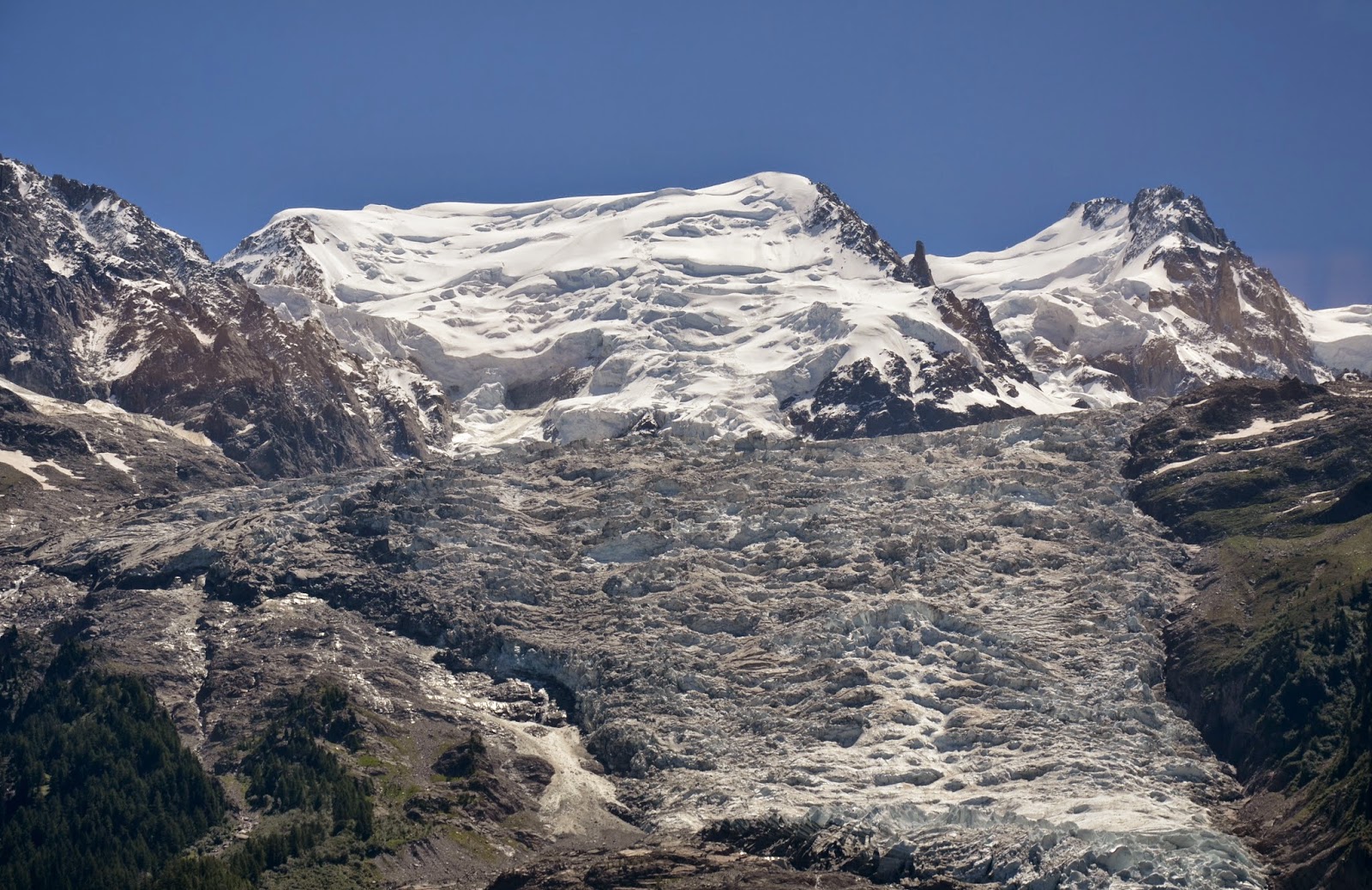
 
Glacier des Bossons overhanging Chamonix on the south side of the valley


When you first arrive in Chamonix, and fix your position relative to the high mountain peaks on the southern side of the Arve river valley, your gaze up towards the Mont Blanc summit is dominated by a huge glacier flowing north, in its slow, inexorable slide down towards town. This is the glacier des bossons. It is a large glacier, but you can see from the physical evidence that it has been rapidly receding in recent decades. But this is not the glacier we visited. To get to our destination you have to get behind the Mont Blanc Massif and into the huge White Valley (Vallée Blanche). There is an even larger glacier there - the mer de glace ("the sea of ice").


Chamonix in centre of valley; the mer de glace and glacier des bossons are the glaciers reaching furthest into the river valley


But to get to the glaciers you need trains. Different types of trains. Now, I don't know about you, but for me one of the enjoyable parts of travelling is negotiating the various types of transportation: planes, boats, rented cars, bicycles, funiculars, cable cars, subways and trains. I particularly enjoy train travel. And the train network in France is excellent - well-organized, efficient, relatively cheap, and quick. SNCF, the company that operates the French national rail service, also runs the inter-city, high-speed train service called the TGV (Train à Grande Vitesse). During a train journey we took between Dijon and Strasbourg, I noticed we were going really fast. I looked up at the electronic sign at the end of the carriage; it listed the name of the next station and the scheduled time of arrival. It also showed the exact speed of the train. In this case, we were moving at 270 km/h. Fast - but soon we started to pick up even greater speed. I kept an eye on the sign. For a stretch of about twenty minutes, we averaged 320 km/h (200 mph).

 
The Mer de Glace is the largest and longest glacier in France

Once you move into mountainous regions, the size and speed of trains changes dramatically. Between Annecy and Chamonix, we had to change trains at Gare de Saint-Gervais-les-Bains-Le Fayet. The rail line taking us into the Chamonix valley - the Saint-Gervais-Vallorcine Railway (dubbed the Mont Blanc Express) - switches from the standard gauge of the national system (1435 mm) to a narrow gauge (1000 mm). The gauge measures the distance between the tracks. The trains on this line travel more slowly; and they're smaller - usually just two carriages. This is because they have to negotiate many stretches of curved track; and they are climbing into the mountains - on one long stretch of over 2 km, they have to negotiate a steep grade of 9%.

 
The Montenvers train to the Mer de Glace glacier uses a rack-and-pinion system - note the toothed rack rail in front of the train, which is grasped by a cog underneath the train


But the train which takes you from Chamonix to the mer de glace glacier is even smaller. The Montenvers Railway terminus is right next to the SNCF station, in the centre of town. The Montenvers line (Chemin de fer du Montenvers) was built in1909 for the tourist trade. It is 5 km long, rising 871 metres (2,858 ft.) from Chamonix to the Hotel de Montenvers station. This is also a narrow gauge track (1000 mm). 


The train leaves Chamonix (near top-right); the line runs through the woods right to left, and then turns north at the edge of the Massif (left-middle); mer de glace is at the top-left of the image


 The gradient on the way up varies from 11% to 22% - too steep for a conventional adhesion railway, in which pressure is simply applied to the wheels, and friction is created between wheels and tracks. For a gradient as steep as this one, a rack-and-pinion system is required - consisting of a toothed rack rail, which usually sits between the two running rails. The train will have one or more cog wheels (or pinions), which then mesh with the rack rail. The Montenvers trains travel at a speed of 14-20 km/h (9-12 mph), taking 20 minutes to reach their destination.

 
The train arrives at the Hotel de Montenvers station

When you reach the Hotel de Montenvers station, you have skirted the north-east edge of the Mont Blanc Massif and are perched on the western slope rising out of the Vallée Blanche. About fifteen metres beyond the exit from the train station, there is a viewing station. You stand behind a low stone wall and gaze at the incredible vista south-west up the valley. Across the valley you can see the peaks of Les Drus and Les Grands Jorasses. Further away, towards the south-west, is Aguille du Grepon. But then you look down, way down. And there it is - the mer de glace glacier.

 
Les Drus on the opposite side of the Vallee Blanche from Hotel de Montenvers

Glaciers, when you think about it, are more like rivers than seas; they flow downhill, pulled by the force of gravity. They are created by the accumulation of snow over long expanses of time. As the depth of snow reaches a critical mass, the pressure of the upper layer turns the lower layer into ice. When there is a sufficient amount of ice layed out on a mountain slope, the gravitational pull will begin to drag the ice very slowly downhill. A glacier has been created. Glaciers form high up in mountains because it snows a lot up there, and it is also cool enough at those high elevations to stall significant melting during the summer season. Glaciers persist because there is a sufficient accumulation of snow to overcome natural ablation - the ice's tendency to melt and sublimate into water vapour.


Colin (in red) looks at Mer de Glace


There are approximately 80 glaciers in the Alps. Mer de glace is the largest and longest of the seven glaciers in France. It originates on the northern slopes of the Mont Blanc Massif. Mer de glace is 7 km long (4.3 miles) and 200 metres deep (660 ft.). It begins at a height of 2,400 metres (7,900 ft.) and flows north by north-west down to 1,400 metres (4,600 ft.). How fast does it flow downhill? In its upper reaches, it is moving at a rate of 120 metres per year (390 ft.); in the lower reaches, near Montenvers, it flows at 90 metres per year (300 ft.), which is 1 cm per hour.


To get down to the ice "caves", the long tunnels that have been cut into the glacier, you face two choices: either you hike all the way down the trail that has been built into the tree-covered cliff; or you take the cable car about half-way down, and then walk down the rest of the way via a long series of steps that have been built and attached to the rock-face. It's about 20-30 minutes if you hike all the way, which is what we decided to do. Going down is  a lot easier than coming up, but even so, in the growing afternoon heat, it was quite the strain.

 
Colin hiking down to glacier - as the sign shows, this point was the height of the glacier back in 1920

When you gaze down towards the glacier, it is not immediately evident that you're looking at ice. The glossy sheen you expect is covered by a thin dirty layer of debris that has been brought by the wind. In 1860 mer de glace extended right down into the valley floor near Le Lavacher. Since then the glacier has been receding south-west towards its origins. This retreat has been rapidly accelerating in the last few decades. You might read about it, or hear it, but when you see the series of little signs attached to the face of the rock, as you climb down the stairs, which announce that this was the level at the top of the glacier only so many years ago, it is quite shocking. You look down to where the top of the glacier is now, and can hardly believe how much of it has disappeared. Seeing is believing.

 
Barbara, in Tilley Hat, looks at sign indicating that this was the height of the glacier only 14 years ago! Look where it is now, way below.


A longer and longer series of metal staircases have had to be attached to the rockface as the level of the glacier has dropped.


Finally you reach the bottom of the long series of staircases pinned to the rock. You notice that there are a dozen or so huge tarpaulins that have been fixed to the top of the glacier. They are there to keep the sun from heating the surface of the ice right above the tunnels that have been cut into the glacier. 


An ice driller. The tunnels have to be re-dug every year - the glacier moves about 90 metres per year.

 
Looking towards the "cave" entrance burrowed into the glacier ice. Note the tarpaulins on top of the ice surface, used to slow melting by the sun.

The gangway over to the glacier


You cross a metal gangway and finally you are standing on the ice. And then you're in - walking along a long tunnel that is about three metres high and three metres wide. It's cold inside. Some people have donned jackets or sweaters, but I manage with just my T-shirt. 

Walking inside the glacier


The frigid air is a splendid relief in there, after the oppresive heat of the cloudless sky outside. There are a few smaller tunnels that branch off sideways, and at the end of the long shaft, which cuts about 100 metres into the ice, there is a circular loop which houses some interesting displays. There are also a few impressive ice sulptures which are set strategically along the main tunnel.

A polar bear sculpture inside the longest tunnel.


The most impressive aspect of the "caves" is the ever-changing light show. There are small lights attached along the side of the tunnels. In fairly quick succession, the colour changes from blue to green to red to pink, and so on. I didn't have a tripod, but even in the dimness of this colured light I was able to get some decent images of Barbara and Colin - especially as we moved back closer to the entrance. Re-setting the ISO on the camera, I was able to shoot at about 1/30 of a second. Not quite fast enough, but sufficient enough to get a reasonable image.

Pink and blue

Looking back towards the tunnel entrance


Colin touches the inside of the Mer de Glace glacier.


Once out of the "cave", we looked up the rock-face to see the climb ahead of us. We decided that this time we'd climb the stairs about half way up the cliff and then take the cable car the rest of the way. 

Cable car up the rockface

I took lots of pictures in all directions: up and down the Vallee Blanche; and gazing up the rock-face towards the cable cars, and then back down at the ice. It's not every day you get to see a glacier, and stroll inside it! You naturally want dozens of images - so that you've fully documented the amazing day that you not only got up close, but actually stepped inside a glacier.


On the Montenvers cog train back to Chamonix


Photographs and Illustrations: two satellite images from Google Earth, 
two maps from the internet; all other photographs © Clive W. Baugh


Resources: Rick Steves' France (2014); Wikipedia articles on glaciers, SNCF Railways, Montenvers Railway, Saint-Gervais-Vallorcine Railway, Rack railways