Tuesday, 4 September 2012

Book Review: Charles Dickens 8 - "Dombey and Son"


Dickens by cartoonist Richard Doyle (late 1840s)
After the last monthly instalment of Martin Chuzzlewit was published in July of 1844, Charles Dickens took a two-year break from novel-writing. His main activity during the ensuing hiatus was travelling with his family in Europe. Just two days after he finished the novel, they were away. There were twelve people in the Dickens’s family and entourage. Their ultimate destination was Italy, but they stopped in Paris for a few days. Then they made their way south in several carriages to the French riviera, crossing the Ligurian Sea by boat to reach Genoa, on Italy’s north-west coast.

They spent a year in Italy. Dickens had plans to write a travel book about his experiences for his new publishers, Bradbury and Evans. He wrote extensive letters to many friends and associates about his impressions and experiences. He collected many of these letters later as background material for the book. He also planned to write another special Christmas story by mid-October. As usual, he got into the habit of taking long hikes – giving him extended time to think about and to plan his future writing. At first he found it difficult writing outside his familiar haunts in England. But finally he got stuck in by the second week of October, and had the Christmas book The Chimes finished by the beginning of November, 1845.

One strange, extended interlude during this Italian sojourn came about through Dickens’s friendship with a couple he met in Genoa – a Swiss banker who had married an English woman. Her name was Augusta de la Rue. Dickens discovered almost immediately after they had met that Mrs. de la Rue was suffering from a nervous, sometimes "hysterical", condition that often left her virtually incapacitated. Dickens, it turned out, had been experimenting with hypnotism – this was the age when “mesmerism” was all the rage. With no medical supervision at all, Dickens persuaded the de la Rues that Augusta might benefit from a course of mesmeric treatments. He hypnotised her many times, and would question her about her life and problems whilst she was under his spell. These sessions were sporadically successful, and Mrs. de la Rue gained some relief from her sufferings. Dickens became fascinated with the case, but his wife, understandably, grew more and more concerned with the impropriety of the situation; and he became annoyed by his wife’s suspicions and her apparent lack of concern for the afflicted woman. His sessions helped temporarily, but Mrs. de la Rue was never to fully recover from her plight.

Dickens as actor - painted by Augustus Egg (1847)
Dickens and his family returned to England in June, 1845. For the next year, he was kept busy with three main projects. The first of these involved amateur theatricals, undertaken to finance a charitable institution. Dickens involved many family members and friends. He took on the role of impresario, producer, director, actor, etc., supervising every aspect of the production – a version of Every Man in His Humour, a satire by the English playwright Ben Jonson. The performance was a tremendous success – and it inaugurated a series of such amateur productions over the next seven years.


Another charitable activity that Dickens got involved with at this time was the founding of Urania Cottage in Shepherd’s Bush. It was to be a home for “fallen women”, former prostitutes who now hoped to establish a new way of life. Dickens established the place with the funding and support of Angela Burdett-Coutts, reputed to be the richest woman in England. She was looking for charitable projects to finance and had been friends with Dickens for some time. Once she gave him the green-light, Dickens threw himself into the project with his usual enthusiasm and commitment. He did most of the planning for the Cottage: he wrote the prospectus, did the interviewing,  the hiring, the designing, and so on. It was a scheme he supported and followed for several years.

The third major activity Dickens got involved with in this period was editorship of a newspaper. His publishers, Bradbury and Evans, proposed the idea, and, as usual, it didn’t take much to convince Dickens to get involved. He hired several family members and friends to fill out the staff. The first issue of the paper – The Daily News – emerged on January 21, 1846. Charles Dickens was a good reporter, a fine journalist, an excellent writer, but, as it tuned out, not a very good editor. He was enthusiastic and meticulous in some things, but he did not have the right temperament for the job. He realised almost immediately - after the initial euphoria of putting out a newspaper had passed - that he had made a mistake. Within 10 days of that first publication he decided to quit. He had a couple of genuine grievances about his position in the enterprise, but was looking for reasons he could use in order, really, to save face. One of his stated reasons was that he realised that he had a new novel in mind that he wanted to get started on.


Rosemount - the Dickens's rented house in Lausanne, Switzerland

To escape the fall-out from his decision to abandon The Daily News, Dickens and family undertook another trip to Europe. At almost the same time that his travel book from the previous trip – Pictures From Italy – was published, Dickens took his family off to Lausanne in Switzerland. He planned to be on the continent for a year, in order to complete a large chunk of his new novel. It took a while for him to settle, but he soon set about plans for the novel and the latest Christmas story. He had never begun two major pieces of fiction at the same time before, and it troubled him for a while. He walked about ten miles each day thinking about the books. The novel came first. He planned the plot’s construction very carefully; there was to be very little extemporizing this time, he knew where he was going from the beginning.

This is the first Dickens novel for which the plans and notes for each instalment survive, and they help to show that he paid as much attention now to the construction of the book’s plot, as he did to its writing. It had been two years since the completion of his previous novel, but once he started, the writing came quite easily. And after he’d finished the second part of the novel, he got busy with the Christmas book, The Battle of Life. He finished it rapidly, doing the final section in just five days.


Wrapper for Dombey and Son
The new novel was called Dombey and Son. As usual, it appeared in twenty instalments over nineteen months – the last issue, as always, being a double instalment – between October 1846 and April 1848. The novel was published by Bradbury and Evans. The illustrations were provided again by “Phiz” (Hablot Knight Browne). It enjoyed quite a good early success – the first instalment sold 25,000 copies, somewhat better than some of his more recent serialised novels. By the end of its run, sales picked up to about 35,000 copies per issue. This success stabilised Dickens’s financial situation. He received £1,500 alone from the first four instalments. He was now one of the highest-paid authors of his generation.

The full title of the novel, as it appeared on the cover page – the green wrapper – was With the Firm of Dombey and Son: Wholesale, Retail and for Exportation. This suggests that Dickens originally intended the work to be focused primarily on mercantile capitalism. If that was the plan, he changed his mind. Paul Dombey senior, the firm’s proprietor, is one of the central characters of the book. But we learn virtually nothing about the nature of his firm’s business. And the reason for its eventual collapse is not explained. The book may reflect society’s dominant interest in commerce and power, but Dickens’s real interest is the moral implications in the relationships amongst the key members of the Dombey family. If Martin Chuzzlewit explores the theme of selfishness – its corrosive effect on a family’s affairs, Dombey and Son examines how excessive pride undermines a man’s family and destroys his marriage. But the novel ends by showing that contrition and forgiveness offer the possibility of redemption.

The dying Paul attended to by sister Florence
At the beginning of the novel, the focus is on Dombey’s young son, Paul junior. His father sees the young boy merely as his heir and successor – the “Son” of the Dombey and Son enterprise. He utterly ignores the existence of his older child, Florence, meanwhile, because she is a girl and, therefore, unable to inherit the family business. But from the first, Paul junior proves to be a frail child. He manages to survive a sickly infancy, only to succumb as a young lad. In a re-run of the demise of Little Nell in The Old Curiosity Shop, Dickens revels in the build-up to the boy`s pathetic death. And it caused the same sensation amongst his readers as the fate of Little Nell had done in the earlier book. Some critics thought he had overplayed the pathos, but the Victorian public had a much higher tolerance of sentiment than a modern audience. They lapped it up. William Thackeray, author of Vanity Fair, who could be a sharp critic of Dickens at times, had this reaction to Dickens’s description of young Paul`s death: “there is no writing against such power as this”. Although I found the lingering, drawn-out account of the boy’s decline tiresome, it is interesting to see how Dickens gives us the entire extended narrative of Paul's decline from the child’s viewpoint.

After the death of Paul Dombey junior, at the conclusion of the novel’s fifth instalment, Dickens found it difficult switching the focus of the narrative over to Dombey’s daughter Florence, the older child. He always had trouble portraying young female characters – invariably they were just too insipid and angelic. Florence is typical, in this regard – perhaps even more so. The sense of her unreality is so strong, she seems at times to be a fairy-tale princess. And the obsequious regard she shows for her cruel and tyrannical father is hard to take. She is another example of Dickens’s tendency to portray motherless daughters as angels who sacrifice themselves continuously for undeserving fathers or grandfathers. Again we are reminded of Little Nell.

And then there’s the character of Edith Granger, the daughter of Mrs. Skewton. She is herself a widow, and becomes the second wife of widower Paul Dombey. The portrayal of their courtship and marriage begins in a promising way. Edith has no romantic or friendly interest in Dombey at all. In fact she despises him pretty much from the moment they meet. But she is pushed into wedlock by a domineering mother who is desperate to have her child married into big money. Dickens seems to be focused on the issue of patriarchy in Victorian society, and how middle-class and upper-class women are restricted pretty much to marriage in order to establish themselves in life. But then the relationship between Paul and Edith Dombey veers into melodrama. They try to outdo each other in pride and arrogance, and become locked into a kind of psychological death-spiral. The depiction of Edith’s behaviour wallows in purple prose and over-the-top situations. Dickens draws on his experience of the London stage, here, and the drama descends into typical melodrama. There is some complexity and intrigue in Edith’s character, but Dickens does over-writes scenes too much.

One of the key problems with this novel is that several of the central characters are not that compelling. In previous novels, shoddy construction was often compensated for by fascinating protagonists. There are some interesting characters here, but they usually take up minor roles. Captain Cuttle, a retired skipper and friend to Solomon Gills and his nephew Walter Gay, is a delightfully-drawn and good-hearted man. Major Bagstock, a retired army officer, is a pompous and egocentric blowhard, who – strangely – becomes a travelling friend and confidant of Paul Dombey. Robin Toodle (‘Rob the Grinder’) is another of Dickens’s young whippersnappers; he starts as a charity schoolboy, but becomes a spy for Mr. Carker.

Two successful characters that do play major roles are Mrs. Skewton and James Carker. Cleopatra Skewton is a delightfully obnoxious woman; she is one of Dickens’s most memorable monsters. She talks about herself non-stop and is a completely insincere person – all façade, no substance, completely artificial. In a wonderful passage, Dickens describes how she is physically “constructed” each morning by her maid, and then “dismantled” each night. James Carker is Mr. Dombey’s confidential clerk and the manager of his firm. He represents the new managerial class running commerce and industry. He is an immoral opportunist. He has abandoned his brother and sister to poverty. Dickens encapsulates his sly deviousness by often depicting him primarily as a walking, strutting pair of gigantic white teeth.
James Carker's manic flight from Dijon
Dombey and Son, despite Dickens’s careful attention to its construction, has major structural flaws. He uses his usual trick of creating a mystery, then delaying its solution until late in the novel. In this case, it involves a set of redundant sub-plots involving James Carker - thrown in towards the end of the book. And the long-absent characters of Walter Gay and Solomon Gills also turn up within a chapter or two of each other near the conclusion of the tale. Dickens had difficulty regaining the momentum of the plot after the death of little Paul Dombey. The struggle between Paul and Edith Dombey goes on too long. And the redemption of Mr. Dombey at the end seems improbable and inappropriate. Dombey and Son doesn’t quite seem the book Dickens intended; despite his careful plan, his focus seemed to shift away from a critique of capitalism and patriarchy to a portrait of a family. What holds the book together – apart from its vigorous writing and some compelling characters – is the relationship between the negligent and cruel Mr. Dombey and his daughter Florence. Maybe Dickens should have called the book Dombey: Son and Daughter.

When I set out, on a previous occasion, to read through all of Dickens’s novels chronologically, I floundered during the process part way through this book. Now I know why. For me, it’s his least interesting and successful. It’s worth a first read, for sure, but I don’t think I’ll be back.

[2012 is the bicentenary of the birth of Charles Dickens. Lots of special events and activities are planned in England this year. Back in 2009, my good friend Tony Grant (in Wimbledon, UK) and I did a pilgrimage to three key Charles Dickens destinations - his birthplace in Portsmouth (the house is a Museum), the house he lived at on Doughty Street in London (now the chief Dickens' museum), and the town he lived in as a child on the north-coast of Kent (Rochester). 

These visits inspired me to begin reading through all Dickens's novels. By last summer I had done six, but stalled in the middle of Dombey and Son. I thought what I could do to mark this special year of Charles Dickens was to start again, read through all 14 of his novels inside the year, and blog about them. I'll give it a try, anyway! So this is the eighth of a series.]

Next: David Copperfield

[Resources used: "Introduction" to Dombey and Son by Lucy Hughes-Hallett (1994); Dickens by Peter Ackroyd (1990); "Portraits of Charles Dickens (1812-1870)", an excellent web-page collection of Dickens pictures.  Dickens Portraits ]


Thursday, 9 August 2012

Photo Essay: Twinings on The Strand


Tony stands outside 216, The Strand
On July 10 my good friend Tony and I did an epic, Dickens-related hike through Central London, beginning at Charing Cross Station and ending at the Charles Dickens Primary School in Southwark (south of the Thames).


Much of our walk took us to places on, or near, Fleet Street and The Strand. We were looking for residences and institutions tied in some way to the life and career of the great English novelist Charles Dickens. But when we got to 216, The Strand, I suggested we step inside, rest our aching feet for a while and enjoy a cuppa - because this is the home of Twinings Tea!


On this very spot in 1706 Thomas Twining opened the first tea room in London. The shop has been here ever since - which makes it the oldest shop in the City of Westminster. And the Twinings family still owns the brand and runs the shop.
 
Thomas Twining - founder of Twinings Tea


As a fan of loose tea who lives in Canada, I know the Twinings brand well. It is the only loose tea generally available in Canadian supermarkets. They sell about half-a-dozen varieties in differently-coloured 100-gram tins. But for some reason, they don’t sell loose Darjeeling tea in the Canadian market. I had to get inside to replenish my own personal stock.


As you prepare to cross the threshold into 216, The Strand, you can’t help but notice the dramatic figures perched above the doorway – and the distinctive Twinings’ logo, created in 1787, and the oldest commercial logo in continuous use. Those figures, of course, conjure up thoughts and images of European exploration in China and the trade that would be opened up with the East.

Darjeeling tea (marketed as a black tea, but it's really an oolong tea, being incompletely oxidated).

The term tea refers both to the plant itself (camellia sinensis) and the beverage that is obtained by infusing its prepared leaves in boiling water. The tea plant is an evergreen and grows primarily in Asia; it usually requires a tropical or sub-tropical climate in order to thrive. There are two main types of tea. The China plant (camellia sinensis sinensis) yields green tea – it is the source of most Chinese, Formosan and Japanese teas. The Assam plant (camellia sinensis assamica) yields black tea – it’s the source of most Indian and other teas. The tea plant thrived originally in that area of Asia bordering north-east India, northern Burma, and south-west China. The drinking of tea seems to have begun in China. It was first imported to Europe by the Portuguese in the sixteenth century.


Close-up of some of the teas on offer in Twinings shop on The Strand

Twinings became first a purveyor of quality teas, and then they started developing their own blends. They claim to be the first company to have blended Earl Grey (although Jacksons of Piccadilly – now owned by Twinings! - also claim that historical credit). Their shop on The Strand is a long, narrow room. The walls on either side are full of wooden shelves stuffed with an impressive array of green and black teas. Some are everyday, cheap varieties; others are very expensive, limited offerings. It's about $3.00 per 100-gram packet for the cheapest loose tea. But you might pay $30.00 for the same amount of a more exotic variety.


Tony brews a cuppa at the back of the Twinings tea shop (note the tiny fridge for keeping the milk fresh)

 Not sure which tea to buy? No matter; you can kill two birds with one stone - refresh yourself with a nice cuppa, and try a new blend. There's a fairly wide assortment to choose from at the back of the shop. It only takes a few minutes to boil some water, brew some tea, and sit for a while to talk about tea and admire the historical artifacts on display.

Signing the visitors' book - and checking out some of the previous entries.


Tony and I took a moment during our cuppa to sign the visitors’ book and add a comment. Interesting to check through some of the countries of origin of previous signers. Lots of people who come into the shop must work in the city and drop buy during their lunch-break to stock up on their favourite exotic blend. But lots of customers are curious tourists: some just taking the chance to relax in an interesting historical locale; others, like me - tea-enthusiasts – treating the experience as a brief pilgrimage.


Tony enjoys some tea in Twinings on The Strand

Here’s Tony enjoying a cup of tea in Twinings. He’s been in this shop before. Back in December of 2011 he wrote a blog about a particular visit he made, following in the footsteps of Jane Austen – one of his favourite Victorian novelists. Jane Austen used to shop at Twinings. Here’s a link to his blog:


Packets of loose tea I got from Twinings: Assam, Darjeeling and a more expensive variety from Sri Lanka


A couple more tea-related things for you to check out:


Here’s a link to an amusing essay written by George Orwell in January, 1946 – “A Nice Cup of Tea”.


Here’s a link to a YouTube video in which a member of the Twinings group (Stephen Twining) explains in detail how to brew the perfect cup of tea.

Enjoy!


[Thanks to my pal, Tony Grant, for a fascinating hike through central London. Cheers!]

Wednesday, 8 August 2012

Book Review: Charles Dickens 7 - "Martin Chuzzlewit"

Dickens in 1843 - engraving by Margaret Gillies
By the time that Charles Dickens had completed his fifth novel, Barnaby Rudge, he had been writing almost non-stop for five years, in order to meet the monthly, or weekly, deadlines for the novels’ serialisations (there was a six month gap between the completion of Nicholas Nickleby and the beginning of The Old Curiosity Shop). And for two stretches of about a year each, he was writing two novels simultaneously. The pressure was intense; and he just could not keep up that volume of work any longer, as the obligations of a public career and the duties of family life grew more demanding.
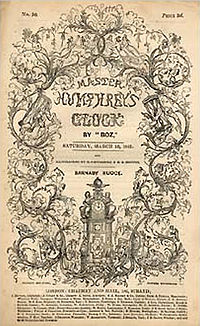
So it comes as no surprise that in July, 1840 Dickens decided that it was time he took a sabbatical from serialized novel-writing. For fifteen months he had been editing - and writing in its entirety – a weekly magazine called Master Humphrey’s Clock. His original idea had been to write a compendium of short stories and articles of topical interest. After a stupendous start, sales of the weekly rapidly plummeted. Readers wanted Dickens the novelist, not Dickens the journalist and yarn-spinner. To revive the magazine’s flagging circulation, he began to serialise The Old Curiosity Shop. And at the conclusion of that phenomenal success, he began immediately into Barnaby Rudge. But he had had enough of the tremendous strain it took being writer/editor of a weekly magazine and, at the same time, the author of very long novels.
So it was that in July, 1840 he decided that once Barnaby Rudge was finished he would close up the magazine and take a rest from writing. His confidence had been rather shaken at times when his periodical did not always sell as he expected. He thought that the public might be getting tired of his work. His plan was to take a year off and then come back refreshed and give his devoted readers another blockbuster novel. He met with his publishers, Chapman and Hall, and proposed that they finance a year’s sabbatical. This was a presumptuous move, since Dickens already owed them £3,000 from when they bought up Dickens’s copyrights and contracts from his former-publisher Richard Bentley. But, as we’ve seen before, Dickens was very sure of himself and the long-term value his name had for his publishers. He persuaded Chapman and Hall to advance him another £1,800 to finance a year of idleness. Nice work if you can get it!
At the same time, Dickens had been seriously toying with the idea of making a visit to the United States of America. He knew he had many admirers amongst the literati there and his bootlegged novels were a tremendous success. He thought he might write a series of essays for magazines, or write a travel book about the country. And when he got a letter from American writer Washington Irving urging him to come over to the new world - telling him that he would be “a triumph from one end of the States to the other”, he became obsessed with the idea of going. It took a while to convince his wife Catherine to buy into the idea – they had four children under the age of five, after all. But by September, his mind was made up. Go they would.

The Cunard steamship Britannia leaving Boston for Liverpool in February, 1844


They left for America from Liverpool aboard the steamship Britannia on January 2, 1842. It was a very rough crossing. They arrived in Halifax, Nova Scotia, on January 20. Describing his first foray into the crowds of North American admirers, Charles Dickens refers to himself for the very first time with the nickname “the inimitable”. Two days later their boat sailed into Boston Harbour. He was intrigued and exhilarated by his new surroundings. He was taken to meet people at the Tremont House Hotel and, when he entered the lobby, he greeted a group of curious strangers with the old pantomime phrase “Here we are!” The whirlwind of events, dinners, meetings, and speeches was exciting at first. But he soon became tired of the constant attention from the pressing crowds. And many of the newspapers began to turn against him after he started to criticise regularly in his speeches the American practice of printing pirated editions of his novels. There should be international copyright laws, he argued, to protect authors like himself from being exploited by unscrupulous publishers.


Dickens in 1844 by Newcastle artist Stephen Humble
And Dickens’s attitude towards American society and culture began to change. Everywhere he looked, he sensed an obsession with business and money. He disliked the people’s coarseness of manner – the constant spitting in public places, for example. He found Americans lacking in humour, self-righteous, insecure, and constantly in need of praise. He witnessed the effects of fame on his everyday life – the lack of privacy and the tyranny of public opinion. And he thought the press was truly dreadful, distorted by extreme political views of all sorts. Despite meeting some interesting people – artists, writers and public figures – who would become friends and future correspondents of his, the overall experience left him with considerable contempt for this new world. He emerged a changed man – one with a new and deeper understanding of who he was as an individual and as an Englishman. It was to have both an immediate and a long-lasting impact on his writing. And would come to feature in his next novel, Martin Chuzzlewit.
Dickens and his wife visited Lowell, New York, Philadelphia, Richmond, St. Louis and Montreal. It was Boston that he liked best. Charles and Catherine Dickens returned to England on the sailboat George Washington. After a three-week crossing, they arrived in Liverpool on June 29, 1842. Within two weeks, Dickens began to write a book about his travels, prompted partly by his need to pay off some of his debt to Chapman and Hall. It was published in October, 1842 as American Notes for General Circulation (a delightful pun – most readers, who would get the reference to publishing, would miss the allusion to money). This travelogue of his American experience was a minor success in Britain; in the U.S., of course, it was almost immediately bootlegged. It was a huge seller in America and, not surprisingly – given Dickens’s forthright opinions about the many things he found contemptible in American society – it created huge criticism. He lost a fair number of friends and a lot of readers. 

Pecksniff and his daughters Mercy and Charity
As he was writing American Notes, Dickens began thinking about a new novel. He wanted to return to a contemporary, topical issue, after trying his hand for the first time at a Walter Scott-styled historical novel with Barnaby Rudge. So he went down with friends to Cornwall, in the south-west of England, to visit a small tin mine. He was thinking of turning his critical attention to mines and mine-owners in his new book. But it all came to nothing. He then took quite a while pondering a subject and looking for a theme.


Dickens began to plot his new novel in early November. He was now regularly attending services at a Unitarian church in Little Portland Street in London. His commitment to Christianity was focused not on theology, not on doctrine, but on the moral and social obligations he found in the Christian message. He was probably looking for a moral theme that he could use in a story of social satire - and some topical characters and settings. Eventually he hit upon the figure of Seth Pecksniff – an embodiment of selfishness and hypocrisy. He and his two daughters are located in a small village near Salisbury, Wiltshire. Architecture, and architects, had been much in the news, recently – and not always for the right reasons. So Dickens made Pecksniff an architect – one of dubious skill and little apparent experience. His real specialty in life was to take on inexperienced apprentices and charge them a handsome annual fee to board in his family home and to receive the benefit of his “professional” instruction.
The first few chapters of Martin Chuzzlewit were quickly written, but Dickens was being uncharacteristically careful in the novel’s planning. He seemed to be putting more thought into the working out of the plot. He wasn’t going to rely on the familiar, picaresque structure that would allow him to improvise at will, as he went along. There was a lot of foreshadowing – later events being anticipated in earlier chapters. He had an overarching theme and, unusual for him, he planned to show moral development in several key characters.


Cover ("wrapper") of the original edition
 Martin Chuzzlewit – published in its original run as The Life and Adventures of Martin Chuzzlewit – was released in 19 monthly parts between January, 1843 and July, 1844. Published by Chapman and Hall, each month’s instalment cost one shilling and consisted of 32 pages of text and two illustrations done by ‘Phiz’ (Hablot Knight Browne). It was spread out over 18 months, and came in at about 500,000 words. Dickens got into a writing groove; he would write the next episode in the first half of the month, and then correct the publisher’s proofs in the second half. He was very happy with his writing, and as the work proceeded, he began to consider it the best novel he had produced so far. As he wrote to his confidante, John Forster:

“… I think Chuzzlewit in a hundred points immeasurably the best of my stories. That I feel my power now, more than I ever did. That I have a greater confidence in myself than I ever had.”

Unfortunately, it was also one of his least popular. The early instalments sold poorly, only about 20,000 copies each (compare that with the 100,000 copies sold each month towards the end of The Old Curiosity Shop). Revenue from advertising dropped dramatically – these monthly publications, like modern magazines, included many pages of advertisements. His publishers, Chapman and Hall, were so dismayed by the relative failure of the book that they invoked a penalty clause in their contract with Dickens. They required him to pay back the money they had lent him, in order to cover their costs. Dickens was incensed, and the situation led to a breach in his relationship with them.
To  revive interest in the novel amongst his readers, he decided to add into his plot a brand new element – he sent the young Martin Chuzzlewit and his man-servant Mark Tapley on a speculative, and ultimately doomed, trip to America, in order to seek their fortunes and escape their failed prospects in England. Dickens decided to use this opportunity to vent his spleen on America and Americans – to focus almost exclusively on the negative aspects of the place. It turned out to provide brilliant comic interludes in the book, but in doing so, it really ruptures the unity of tone and purpose he had already established. As I was reading through these American adventures, I began to find them rather tedious and tendentious and wanted Dickens to get his story back to England. And his American readers, of course, were infuriated by the vitriol Dickens employs throughout this disastrous venture into the new world. And, ironically, the stratagem did not work – the episodes in the U.S. only helped increase sales by a few thousand each month.


Montague Tigg & Chevy Slyme - delightfully obnoxious
 Martin Chuzzlewit, in some ways, is the story of an extended family – and how the figure of Seth Pecksniff serves as a catalyst in the working out of their destinies. It is a novel all about money – the misery it brings into people’s lives: the need to borrow, the political uses of lending, the machinations and jockeying for inheritances, and the fall-out from failed investments. This focus on money reflects Dickens’s own concerns of the moment – the increasing financial demands made upon him by his extended family, and the large debt he owed now to Chapman and Hall. But this obsession with money is subsumed under the larger theme of selfishness. “Self! Self! Self!” several characters apostrophise at different moments in the story.

As usual, Dickens’s story is full of interesting characters. There is Tom Pinch, the put-upon man-servant of Seth Pecksniff, who embodies a sort of feckless, well-meaning, but gullible innocence. He reminds us of Newmann Noggs, the put-upon servant of the malevolent Ralph Nickleby. They both suffer much. But Pinch is in a more extreme case of weakness, because – unlike Noggs – he has a total admiration for his employer and doesn’t see that this ‘benefactor’ is a pious fraud. He represents a Christian ideal and, despite the innocence, stands strong for goodness and loyalty. Another familiar Dickens-type is found in this novel – the lovable and enterprising young scalliwag with the silver tongue. Here it is Bailey Junior, who starts out in the story as boots at Mrs. Todger’s London boarding house, and moves on to work for the rogue Tigg Montague. This ambitious young lad reminds us of the Artful Dodger in Oliver Twist and Kit Nubbles from The Old Curiosity Shop, who works in the service of Mr. Garland. He is on-the-make, but very honest. He’s a smooth talker, but he sticks to the truth. And then there’s the astonishing Montague Tigg – who begins the story as the hanger-on pal of the Chuzzlewit-relative Mr. Chevy Slyme, but later serves as corrupt Chairman of a Ponzi-scheme enterprise known as the Anglo-Bengalee Assurance Company. He’s a loathsome delight, because he swindles in turn some of the most degenerate figures in this world full of hypocrisy and greed. Another smooth talker.
Martin Chuzzlewit is one of Dickens’s best books. Apart from the American episode, it flows wonderfully, and lacks the aimlessness of much of his earlier work. It is sometimes called the last of his picaresque novels; but, really, it marks a break from that technique. It doesn’t rely as much on interesting incident, and adventures-on-the-road; it is more deliberately structured than that. And the heart of the story is not what comes next, but the revelation of the multifarious effects of lives centred on selfishness and the grasping after money. It is ultimately a moral enterprise.

Martin Chuzzlewit is a funny book. In many ways, it is one of Dickens's very best comic masterpieces, because of the way he combines the comic tone with the moral theme. The acerbic satire centres around two of Dickens’s funniest, and most monstrous moral failures: Seth Pecksniff and Sairey Gamp. She is one of his funniest and most famous characters. But there’s a new element here. In addition to his brilliant portrayal of hypocrisy and self-delusion, Dickens shows a concern for the moral development of his characters. The young nephew Martin Chuzzlewit, Pecksniff’s daughter Mercy, even the stereotypical Dickens-innocent Tom Pinch - they all undergo significant change because of the sufferings and travails they go through. This sort of character development is new for Dickens. It shows a significant move away from a reliance on melodrama or farce, and a more complicated notion of novel structure and the interaction between story and character. With Martin Chuzzlewit, Dickens is back to what he does best, and finding ways to make his stories even more satisfying.

The Pecksniff household: Martin Chuzzlewhit, Charity and Mercy Pecksniff, Pecksniff and Tom Pinch


[2012 is the bicentenary of the birth of Charles Dickens. Lots of special events and activities are planned in England this year. Back in 2009, my good friend Tony Grant (in Wimbledon, UK) and I did a pilgrimage to three key Charles Dickens destinations - his birthplace in Portsmouth (the house is a Museum), the house he lived at on Doughty Street in London (now the chief Dickens' museum), and the town he lived in as a child on the north-coast of Kent (Rochester). 

These visits inspired me to begin reading through all Dickens's novels. By last summer I had done six, but stalled in the middle of Dombey and Son. I thought what I could do to mark this special year of Charles Dickens was to start again, read through all 14 of his novels inside the year, and blog about them. I'll give it a try, anyway! So this is the seventh of a series.]

Next: Dombey and Son


[Resources used: "Introduction" to Martin Chuzzlewit by William Boyd (1994); Dickens by Peter Ackroyd (1990); "Portraits of Charles Dickens (1812-1870)", an excellent web-page collection of Dickens pictures.  Dickens Portraits ]

Wednesday, 20 June 2012

CD Review - "Americana" by Neil Young and Crazy Horse


Americana - the new Neil Young & Crazy Horse album
Neil Young doing an album of traditional American folk songs? Not too surprising, eh? Some nice, laid-back arrangements, presumably, dominated by acoustic guitars – similar to the easy-going vibe of Comes a Time (1978)?
 
Well, that’s not what this is at all. This is Neil Young and Crazy Horse. This is garage-band, rough-at-the-edges, crunchy rock, reminiscent of Ragged Glory (1990) - what Rolling Stone magazine refers to as “one of those fraternal freak-guitar slopfests”. I don’t know, is that meant as a compliment?

Traditions - yes,  Americana is an album of traditional folk, but it's done in the traditional Neil Young & Crazy Horse style: rough and loose, nearly all recorded live off the floor without overdubs – the way they like it. And the way I like it too.

There’s 57 minutes of music, here – 11 tracks with fairly tight arrangements - for these guys, anyway. They only really stretch out on “Tom Dula” (their version of “Tom Dooley”), which clocks in at 8:13. The sequencing of the tracks is artful. The less-interesting-because-overly-familiar songs (Stephen Foster’s “Oh Susannah”, for example, or “Clementine”) come early. But then the album presents some more intriguing choices and moves through several changes of pace towards a barn-storming finish.

Americana has been getting very mixed reviews, since its release just over two weeks ago. I reckon some critics have judged it too quickly – jaded by some of its content and alienated, perhaps, by its apparently slap-dash approach and incongruous (for some listeners) arrangements. Some seem to detect an arch and cynical attitude to some of the material, but I don’t hear that at all.

Neil Young - guitar hero
I don’t know about you, but I find I usually stick with my initial impression of a new album. But I will listen to it at least half-a-dozen times before attempting to write about it - even more times, if I find my response is particularly ambivalent. Americana begins with a very ragged intro: Neil picking out a few notes on guitar, then shifting around with some tentative chords – before Ralph Molina starts banging on the drums, and they slide into their groove after half a minute. Immediately it sounds like a jam session – and that ambience is emphasised at the end of the track when the band erupts into laughter off-mic and you hear Neil exclaim to the band: “It’s funky … it’s good … it gets into a good groove.” Indeed. My initial impression? Oh, yeah. Nice!

It may be ragged and hard, but it sounds good. Neil Young has always been concerned about the audio quality of his albums; and he has been a long-term critic of digital sound because of its limited frequency response – especially in the early days of CDs. No surprise, then, to see that this album is an A-A-D production: it was recorded on an Audio Tube console to 2” 8-track analogue tape; then mixed to ½” 2-track analogue tape; before finally being transferred to digital. Yes, it may be ragged, but it sounds good – especially the tone on Neil’s electric guitar!

Neil Young and Crazy Horse - back in the early days.

Americana was produced by Neil Young and John Hanlon. Crazy Horse features Ralph Molina on drums and vocals, Billy Talbot on bass and vocals, and Frank “Poncho” Sampedro on guitar, organ and vocals. Neil, of course, plays lead guitar and sings – with the rest of the band providing a kind of “Greek chorus” style of backing vocals. One of the secrets to the appeal of this long-standing relationship between Neil and Crazy Horse (which goes all the way back to 1968, and was first featured – memorably - on disc with Neil’s second album Everybody Knows This Nowhere in 1969) is the distinctive mixture of hard and smooth in their sound. And that shows here: they thrash away as a hard-rock band, but the vocal backing is sweet and harmonious - if a little ragged. But it's honest and real, instead of slick and air-brushed with auto-tuner.

What we have here, primarily, is a set of campfire songs done in the style of heavy, garage-band rock. There’s Foster’s “Oh Susannah”, the traditional folk pieces “Clementine”, “Tom Dula”,  “Gallow’s Pole”, “Travel On”, “She’ll Be Coming Round the Mountain” (called “Jesus’ Chariot” here), and Woody Guthrie’s “This Land Is Your Land”. And, despite the grunge-styled approach, the campfire mood is retained, and I find myself bursting out into song throughout.

Neil Young’s detailed liner notes for each song reveal an interesting aesthetic throughout. Although nearly all the material is traditional folk, they deliberately choose arrangements that pay tribute to pop and folk-rock versions of the songs from the fifties and sixties. “Gallows Pole”, for example, is based on the Odetta version from the ‘60s. And the group’s rendition of “Travel On” is based on a Paul Clayton arrangement - which is itself based on a 1958 version done by Billy Grammer. Reading the notes, then, heightens the sense of the historical continuity the band brings to these old songs. 

Neil - still rockin' out!


And there are some surprises. They do a very sloppy version of the doo-wop classic “Get a Job” – using the original arrangement by The Silhouettes. Neil claims this is a folk song – because of its proletarian subject matter. Hmm …  And one of the highlights of the disc, for me, is a bluesy rendition of “High Flyin’ Bird”, a song written by Billy Edd Wheeler for The Company. Neil and band copy the arrangement recorded by The Squires in 1964, which had Neil’s colleague Stephen Stills on lead vocals. This is a moving song:
“There’s a high flyin’ bird way up in the sky;
And I wonder if she looks down as she flies on by,
Just floating so free and easy in the sky;
But look at me here, I’m just rooted like a tree here,
I got them sit down, can’t fly, oh Lord, I’m gonna die blues.”

Oh, and if you are looking for a folky acoustic guitar piece - there is one that Neil does: it’s a lovely version of “Wayfarin’ Stranger”, based on Burl Ives’ 1944 recording.

But the two epics here are the Woody Guthrie piece and a clever version of “God Save the Queen” – no, not The Sex Pistols classic, but the British national anthem. For Guthrie’s “This Land is Your Land”, Neil adds a choir and brings in Stephen Stills and wife Pegi to help with the vocals. A real campfire feel here. Good to see, too, that Young goes back to the original Guthrie lyrics. Most people are probably only familiar with the adapted lyrics of Peter, Paul and Mary – where the song became a kind of paen to the beauty of the America landscape. Guthrie’s song is political protest – it’s actually about the tyranny of private property – how it separates the people from land that is rightfully theirs to enjoy.

“As I went walking, I saw a sign there,
And on the sign it said ‘No Trespassing’,
But on the other side, it didn’t say nothing -
That side was made for you and me.”

Neil Young


The album closes with an intriguing version of “God Save The Queen” – not designed, as some might think, or hope, as a tribute to Elizabeth II’s diamond jubilee! No, it’s a folklorist’s approach – arranged as  a clever medley. The track starts with the first two verses of the British national anthem; and then morphs seamlessly into the American song “My Country ‘Tis of Thee”, which shares the same tune. The transition, Neil writes, is “in recognition of the War of Independence and America’s transition to freedom.” An interesting way to finish the album – for a former Commonwealth citizen, and now long-term resident of the United States.

So, this is probably the most interesting album that Neil Young and Crazy Horse have put together since 1996’s  Broken Arrow. And it’s not just grunge-rock renditions of old folk songs. There’s a lot more going on than that. And a few real gems. If you dig the Neil Young with Crazy Horse brand, you’re likely to enjoy their latest album. I did – but as a long-term folky and Neil Young fan, that’s really no surprise, is it?


Sunday, 3 June 2012

Book Review: Charles Dickens 6 - "Barnaby Rudge"


Dickens in 1841 - lithograph from a lost portrait
Barnaby Rudge, Charles Dickens’s fifth novel, could very well have been his first. He conceived of it early in his writing career. Twice he contracted himself to writing it, but then twice he delayed. The novel had the longest and most convoluted gestation of all his books.

In early May 1836, the 24-year-old author signed an agreement with publisher John Macrone to write an historical novel to be called Gabriel Varden, The Locksmith of London. Macrone had published Dickens’s first book, Sketches by Boz, only a couple of months earlier. The up-and-coming writer was now planning a novel. In return for his commitment, Macrone gave Dickens an advance payment of £200. 

But Dickens had already begun writing a serialized novel for Chapman & Hall, and the first installment of The Pickwick Papers was printed at the end of March, 1836. Work began to pile up for the ambitious author. Before long he had too much on his plate, and he asked to be released from his agreement with Macrone later that year.
About a year later, in the autumn of 1837, as The Pickwick Papers neared the completion of its monthly serialisation, Dickens began to think again of Gabriel Varden. But his plans for the novel were diverted again – this time by the writing of Nicholas Nickleby for Chapman & Hall. Dickens had also taken on the job of editing a monthly magazine back in late 1836 for a third publisher, Richard Bentley. He promised Bentley that he would eventually deliver a new novel, the long-delayed Gabriel Varden, in October of 1838. But these plans were also postponed. 

In 1839, after the Dickens household had moved from Doughty Street to Devonshire Terrace, Dickens began writing the novel in earnest. He had two chapters completed, but then suddenly broke off, annoyed and offended by certain business disagreements with Bentley. He weaseled his way out of his contract with Bentley – exerting the power he had developed now over publishers, because of his enormous commercial success.

Finally, Dickens got serious about the novel, after he had finished publication of The Old Curiosity Shop in Master Humphrey’s Clock – a weekly periodical he was editing for publishers Chapman & Hall. He knew from experience that his magazine would only flourish if he included the serialisation of one of his own novels. A new one was required after the incredible success of the story of Little Nell. So, the long-delayed historical novel finally emerged. He began writing on January 29, 1840 – only eight days after completing The Old Curiosity Shop. He quickly had a third chapter finished – to add to those he’d completed the previous year.

Cover wrapper of Barnaby Rudge
Barnaby Rudge was written and published in 88 weekly parts between February 1840 and November 1841. It was illustrated by George Cattermole and Hablot Knight Browne (‘Phiz’). Once he got into it, Dickens wrote rapidly. At the beginning of June, for example, he wrote four chapters in only six days, averaging about 2,300 words a day!  And in July he knocked off six chapters in twelve days. But this was a different kind of book than that with which his audience was familiar. At the height of the frenzy for The Old Curiosity Shop it was selling 100,000 copies. Barnaby Rudge managed about 30,000.

If Barnaby Rudge had been Charles Dickens’s first novel, and a success to boot, his career might have turned out dramatically different. The Pickwick Papers –  after a slow start – became a huge hit. And it established the young author as a comic novelist recognised more for his brilliance in the creation of characters, than his ability to create well-structured plots. Even when he turned his hand to more melodramatic novels like Oliver Twist, Dickens used characterisation – exaggerated and often grotesque – to advance his story. His novels worked best when based on satire, rather than plot. Barnaby Rudge, however, ran counter to that mold. It was an historical novel, written in the style of Walter Scott.

Barnaby Rudge, A Tale of the Riots of Eighty (to give it its full title) has a more carefully-structured plot than is usual for Charles Dickens. And that may be the result of his having delayed it so long, but thought about it, therefore, for nearly five years. It tells the story of the Gordon Riots of 1780 – a series of anti-Catholic protests. In 1778, the English government had enacted the Papists Act. This act eliminated some of the harshest penalties that had been imposed on Roman Catholics in England by the Popery Act of 1698 – such as the need to swear an oath of loyalty when entering the armed forces. Lord George Gordon became President of the Protestant Association in 1779 and he fomented vigorous opposition to the legislation. He and his followers achieved some success in Scotland, but things turned out differently in England. On June 2, 1780, a huge crowd of about 50,000 people marched on the Houses of Parliament in London, in support of Gordon’s political initiative at Westminster. But Parliament voted against Gordon’s motion 192-6. An initial peaceful protest turned into widespread rioting, looting, and destruction. The army was finally called out on June 7th. 285 people were shot dead; about 200 were wounded. Lord Gordon was arrested and charged with high treason, but later acquitted.

The Gordon Riots - a painting by Charles Green

Barnaby Rudge provides a gripping account of the riots in London, which begin about half-way through the book. Beforehand, though, he establishes a set of characters in the village of Chigwell, north-east of London: there are working people centred around the Maypole Inn and aristocrats living in a mansion nearby called The Warren. These characters intersect with some Londoners: the family of Gabriel Varden, a locksmith, and Barnaby and Mary Rudge, whose history is tied to the residents of The Warren. In a series of typically Dickensian coincidences, all of these characters are drawn into the events of the Gordon Riots, a few taking on prominent roles in the protests and riots.

Barnaby Rudge is one of the least-known and least-admired of Dickens’s novels. It has only been adapted for TV and film twice – a silent film made in 1915 and a BBC production back in 1960. It is easy to understand why. It is one of only two historical novels that he wrote (the other being A Tale of Two Cities). Dickens was at his best writing social satire full of broad and humorous characterisation. And that is not what this book is about. But he does employ some familiar techniques.


Simon Tappertit, the locksmith's apprentice (left), Gabriel Varden and Dolly Varden - by 'Phiz'

There are some comic characters – the usual puffed-up and pompous types typical in Dickens: there’s Simon Tappertit, an apprentice of the locksmith Gabriel Varden, and captain of the ‘Prentice Knights; and the shrewish Miss Miggs, the domestic servant of Mrs. Varden. There are some villains: the loathsome aristocrat Sir John Chester; and the devious Mr. Gashford, secretary to Lord Gordon. And there are some innocent and ineffectual young women, of the usual Dickensian-type, providing love-interest: Dolly Vardon and Emma Haredale.


The Maypole's sinister ostler Hugh - engraving by 'Phiz'


But there are some more interesting and ambivalent characters, too. There’s John Grueby, a servant to Lord Gordon, who turns against the immorality of Gashford and the mob. There’s Geoffrey Haredale, a country gentleman, who can be harsh and abrupt, but is also honest and unselfish. And then there’s Hugh, the wild and rugged ostler at the Maypole Inn, who becomes a leader of the rioters. In the early part of the book he is nothing more than a bestial thug. During the riots, however, he becomes an unlikely leader – almost heroic in his manic energy, a Joan-of-Arc figure who mounts the barricades. And, later, unlike most of the other rioters, he shows a lack of cant, and real sympathy for Barnaby, the innocent young man condemned to die for his role in the riots.


Barnaby Rudge and Grip, the raven - by Fred Barnard


The character of Barnaby Rudge is another intriguing innovation from Charles Dickens. In Oliver Twist, he made a young child the centre of his novel – something, apparently, never done before. And in Barnaby Rudge, he has a title-character who is mentally-handicapped. He is referred to occasionally as the “idiot boy”. William Wordsworth had a poem called “The Idiot Boy” in his Lyrical Ballads (1798). It tells the story of his mother, Betty Foy, struggling to protect her child. The idea of the simpleton representing a kind of naïve and uncorrupted innocence in contrast to the evils found in the world is a theme of the Romantics in the early-half of the nineteenth century. Just as Oliver Twist serves, in his innocence, as a contrast to the depravity of London low-life, so Barnaby Rudge contrasts with the machinations and deceits of the world around him. And his long-suffering mother, Mary Rudge, is the Betty Foy of the book.

Barnaby Rudge was originally titled Gabriel Varden, the Locksmith of London. And one can see why. Varden is introduced as a benevolent, hen-pecked, Pickwickian-type. But he becomes heroic in the climactic section of the book with his open defiance of the mob. They come to his house and ransack the place. They drag him off, with a bag of his own locksmith tools, and try to force him to open Newgate Prison, so they can free all the prisoners and destroy it. He refuses to help them. They drag him off and you fear the worst.

And then there is Grip, the talking Raven – a fascinating character. Grip was a Dickens family pet. It wasn’t their first pet raven, either. Just after Dickens had begun working on Barnaby Rudge, Grip died (from eating too much lead paint, apparently). He had always been fascinated by the bird, and he wrote some facetious letters to friends announcing Grip’s untimely demise. To his artist-friend Daniel Maclise, for example, he wrote:

“You will be greatly shocked and grieved to hear that the Raven is no more. … On the clock striking twelve he appeared slightly agitated, but he soon recovered, walked twice or thrice along the coach-house, stopped to bark, staggered, exclaimed “Halloa old girl!” (his favorite expression) and died.”

Grip, the raven

Despite the fact that the raven liked to bite everyone’s ankles, the children loved the bird and begged their father to make the animal a character in his new book. And he did. Grip is portrayed as the faithful and much-loved pet of Barnaby, who carries him around in a wicker basket. After Grip's death, Dickens had him taxidermied. When Dickens himself died, the stuffed raven was sold at auction. It eventually came into the hands of American collector Colonel Richard Gimbel, who donated it to the Free Library in Philadelphia in 1971.

But the story doesn’t end there. The American poet and short-story writer Edgar Allen Poe reviewed Barnaby Rudge in 1841 for Graham’s Magazine. He thought that the raven could have been given a more symbolic and prophetic role. He focused on the incident in Chapter Five when a character hears a noise, and asks: “What was that? Him tapping at the door?” referring to Grip. “ ’Tis some one knocking softly at the shutter,” says Mary Rudge, “Who can it be!” Poe met Dickens a year later, during his 1842 speaking tour of the United States. They got on well, and commiserated with each other about the lack of copyright protection for authors of their day. In early 1845 Poe published “The Raven”, his poem about a talking raven, and its ominous refrain of “Nevermore”.

Most of Dickens's novels, we've learned by now, have an essential mystery at the heart of the story - there is invariably a mysterious stranger hovering on the edges of the scene, usually having something to do with the identity of someone's child, or someone's parent. Barnaby Rudge is no exception: there is a mysterious figure who enters the plot early as a kind of ominous highwayman. He regularly reappears - harassing Barnaby's mother, Mary Rudge, who holds some dark secret about his past history. It's all tied up with the fate of Geoffrey Haredale and his niece Emma.

Sir John Chester and son Edward - wood engraving by 'Phiz'
Just before Dickens began to write Barnaby Rudge he had another set-to with his father, John Dickens. Dickens Senior had been running up debts again, and charging things to his son Charles's accounts. This had been happening almost constantly since Charles had become not just financially independent, but actually, at times, quite wealthy - although he had many people, institutions and artistic enterprises that he continued to support. Suffice it to say that he earned a lot of money, but his lifestyle involved very high expenses. The situation with his father got to the point where Charles felt obliged to publish an announcement in several of London's daily newspapers disavowing himself of any charges made against his name through his father. He went so far as to encourage his parents to move abroad. Eventually, he bought a house for them in the south-west of England, where they lived for several unhappy years, before coming back to the capital. Conflict between father and son emerges early as a theme in the new book. The young gentleman Edward Chester is thwarted at every turn by his malevolent father Sir John Chester. And young Joe Willet is thwarted and condescended to by his tyrannical father, the innkeeper John Willet. Not surprising that the older Willet and the older Chester share the same name as Dickens's own father - John. Presumably, Charles's father made note of the fact.

Eighteen years were to pass before Charles Dickens wrote another historical novel (his second) in 1859 - A Tale of Two Cities. It also had as its theme rebellion and revolution. As a progressive, Dickens had sympathies for the vast urban underclass of his era. He disliked unearned wealth and inherited privilege. He admired men of energy and ambition, like himself, but he did not support unfettered capitalism. He was a social reformer – he understood the dangers of revolution. His graphic and gripping depictions of the mayhem wrought by ‘His Majesty King Mob’ during the Gordon Riots of 1780 are reminders of what an unruly crowd can do. The account makes the novel worthwhile to those with an interest in the London of that period. But if it’s the comic characterisations and social satire you appreciate in Dickens’s work, this is one of his novels you might want to skip.


Simon Tappertit, the captain of the 'Prentice Knights - engraving by 'Phiz'


[2012 is the bicentenary of the birth of Charles Dickens. Lots of special events and activities are planned in England this year. Back in 2009, my good friend Tony Grant (in Wimbledon, UK) and I did a pilgrimage to three key Charles Dickens destinations - his birthplace in Portsmouth (the house is a Museum), the house he lived at on Doughty Street in London (now the chief Dickens' museum), and the town he lived in as a child on the north-coast of Kent (Rochester). 

These visits inspired me to begin reading through all Dickens's novels. By last summer I had done six, but stalled in the middle of Dombey and Son. I thought what I could do to mark this special year of Charles Dickens was to start again, read through all 14 of his novels inside the year, and blog about them. I'll give it a try, anyway! So this is the sixth of a series.]

Next: Martin Chuzzlewit


[Resources used: "Introduction" to Barnaby Rudge by Peter Ackroyd  (2005); Dickens by Peter Ackroyd (1990); "Portraits of Charles Dickens (1812-1870)", an excellent web-page collection of Dickens pictures.  Dickens Portraits ]